|
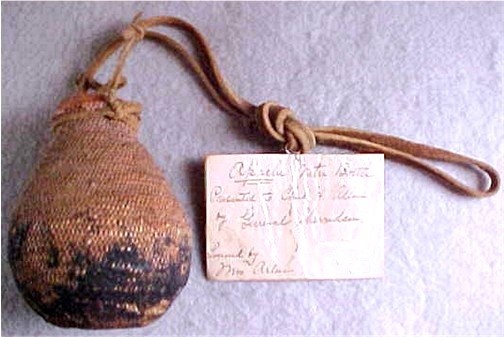
APACHE OLLA PRESENTED BY GENERAL OF THE ARMY
PHILIP H. SHERIDAN TO CONGRESSMAN CHARLES H. ALLEN ca.
1886 – INTERESTING IDENTIFIED HISTORICAL ARTIFACT IN
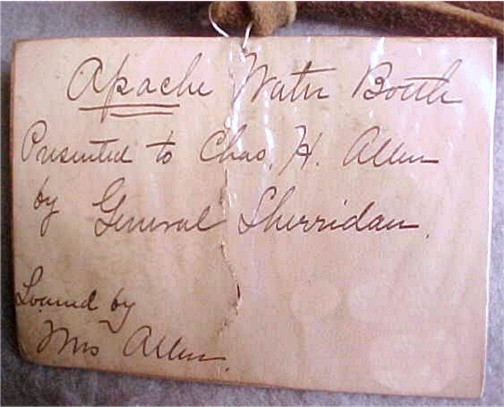
EXCELLENT CONDITION: A very unusual Apache
basket woven olla /o-ya/ in that it is of a very
diminutive scale, bearing a handwritten card identifying
this vessel as having been presented by General of the
Army Philip Sheridan to Congressman Charles H. Allen of
Massachusetts.
In addition to being an excellent example of the Apache
basketry art, as will be explored below, this olla
passed as a gift between two prominent figures in the US
Government in what could only have been a very narrow
window of time.
General Sheridan is a well known historical figure,
familiar to any serious student of the Civil War and the
Indian Wars which followed, but there are some specific
events in the later years of his career which reflect
directly on this presentation piece.
Sheridan, as so many officers who were on active duty at
the beginning of the war, rose dramatically in rank,
entering the war as a captain and having attained the
regular army rank of major general by the cessation of
hostilities. Remaining in the army, he was appointed as
the commander of the Department of the Missouri in 1867,
and promoted to lieutenant general in1869, making him
one of the most senior officers in the army.
Of no surprise to anyone at the time, in 1883 Sheridan
was appointed by President Cleveland to succeed William
T. Sherman as the Commanding General of the Army upon
Sherman’s retirement. As he assumed command, the
primary focus of the army’s efforts was centered on the
Arizona Territory and the unrest among the Apaches. In
May of 1885, for a number of different reasons and
grievances, Nana, Geronimo, and other Apache notables
led their followers off their reservations and began an
extended campaign of attacks against ranches and
settlements throughout far western Texas, New Mexico and
Arizona, and down into Mexico. The resulting
depredations held the attention of the nation, and the
army was expected to bring the hostiles to bay.
As the events unfolded on the reservations, Sheridan and
his wife were on a train borne tour of the southwest
United States, and although I have found no record of
the trip, I do not believe the general’s presence in
that area was coincidental. No doubt the Apache
situation had drawn the general’s full and undivided
attention and the trip provided him ample opportunity to
review the situation for himself. While in California
the couple was aboard a train that was involved in a
serious accident which nearly proved fatal for both.
Sheridan suffered a serious head injury, and the
decision was made to begin the return trip back to
Washington. In May of 1885, as the Apaches were
beginning to leave the reservations, Sheridan was
passing east bound through the Arizona Territory and
northern New Mexico, and it is known he halted in
Lordsburg, NM for a meeting. No doubt the Apache
troubles were the topic of these meetings, as they were
everywhere across the region, and the general would have
availed himself of the opportunity to gather information
from as many of his field commanders as possible during
this trip.
This olla was likely gifted to Sheridan by one of the
officers serving in Apacheria when he met with the
general. Whether the officer purchased or traded for
the olla from an Apache on one of the reservations, or
if he acquired it in the course of a campaign in the
field, he had an eye for quality and he recognized the
unique nature of this piece, and it was an appropriate
piece to present to a senior officer of Sheridan’s
stature. By the early spring of 1886, Sheridan was back
in Washington, and so it happens, so was Charles H.
Allen.
A native of Massachusetts, Allen was only thirteen at
the beginning of the Civil War and his war years were
spent as a student, graduating from Amherst College in
1869. He joined his father’s successful lumber business
and by the early 1880’s he had entered politics, joining
the Republican Party and serving two terms in the
Massachusetts House of Representatives and one term in
the Massachusetts Senate. His political career
continued when he was elected (R-Mass 8TH
District) to the U.S. 49TH and 50TH
Congresses, serving from March of 1885 through March of
1889 – specifically, at the same time of the Apache
troubles described above.
While both men were in Washington at the same time, and
their respective duties certainly encompassed
interlocking circles of oversight, budgeting, personnel
appointments, and constituent concerns, once I began
researching the lives of the two men I was hopeful of
finding a commonality which would have predicated
Sheridan presenting this Apache Olla to Allen. I
believe I have discovered two possibilities.
Following several summers of camping in Dartmouth, MA
farm fields, in 1872 a group of investors formed a
corporation, Nonquitt Beach and Wharf Association, which
purchased five of the farms, divided the land into house
lots and began building individual residences. The
Sheridans first summered in Nonquitt in 1887 in a rental
cottage, and enjoying the area they built their own
cottage and first occupied it in the summer of 1888.
Unfortunately, early in 1888 the General suffered a
series of severe heart attacks and his health failed.
Recognizing that his time was short, Congress acted
swiftly to introduce and pass legislation to promote
Sheridan to General of the Army on June 1, 1888. While
the chronology of these events is not entirely clear,
what is known is that Sheridan’s family moved the
General out of the oppressive Washington heat that
summer to the newly built cottage in Nonquitt. Upon
passage of his promotion, the historical record relates
that a congressional delegation traveled to the stricken
general in order that they could deliver the news of his
promotion in person. Whether the delegation traveled to
his home in Washington before he was moved, or if they
traveled to Nonquitt is not known. The General remained
in Nonquitt for the balance of the summer until he died
on August 5 of that same year. His body was returned to
Washington for the funeral and he was interred at
Arlington Cemetery.
Allen was a native of Massachusetts and surely was aware
of the growing vacation community in Nonquitt.
Sheridan’s public profile, his popularity throughout
most of the country (understandably, not so much in the
Southern states), his social rank as the Commanding
General of the Army, and the Sheridans having
established a summer residence in the fashionable
Massachusetts seaside community, it would have been
natural for Allen to have been drawn to Sheridan.
Likewise, as Allen was a serving member of the very
Congress which promoted Sheridan to the highest rank, as
well as holding the purse strings upon which the army
heavily depended, and being a representative from the
very state where Sheridan had established a residence,
Allen was the sort of person the General would have been
wise to curry as a friend. In the circles of
Washington and the Massachusetts social world, the two
men both stood to gain from a mutual friendship. It is
possible Sheridan presented the olla to Allen in the
course of their official contacts in Washington, or
perhaps, as it would have been natural for Allen to have
been part of the delegation that traveled to
Massachusetts to present the general with his promotion,
the presentation was made at the Nonquitt cottage.
Either way, the gift from such a notable personality
must have been well received.
Allen enjoyed a long and varied career in public
service. In addition to his terms of office in the
Massachusetts House and Senate, and the US Congress,
Allen served as the Massachusetts Commissioners of
Prisons, and in 1898 he was appointed as the Assistant
Secretary of the Navy when Teddy Roosevelt vacated the
position to lead the Rough Riders during the Spanish
American War. After the war, President McKinley
appointed Allen as the first civilian US Governor of
Puerto Rico where he served from 1900-1901. After
resigning as governor, Allen entered Wall Street,
joining the House of Morgan. Through those connections
he created a sugar syndicate in Puerto Rico, which
eventually controlled in excess of 90% of the sugar
capacity of the United States and today is known as
Domino Sugar. Allen passed away in 1934 in Lowell,
Massachusetts at the age of 86. His wife, Harriet
Coleman Dean, preceded him in death, passing in 1925.
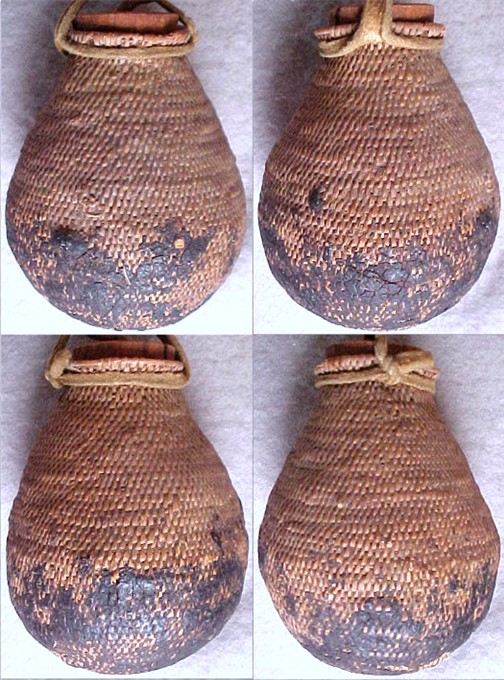
While being fashioned in the same weave and style as the
larger, more commonly encountered examples, this olla
only measures 5” high and 4” in diameter at the widest
point of the swell. The weave is completely intact with
no separation, no breaks, and no wear to the rim of the
mouth, and the vessel still retains its full form with
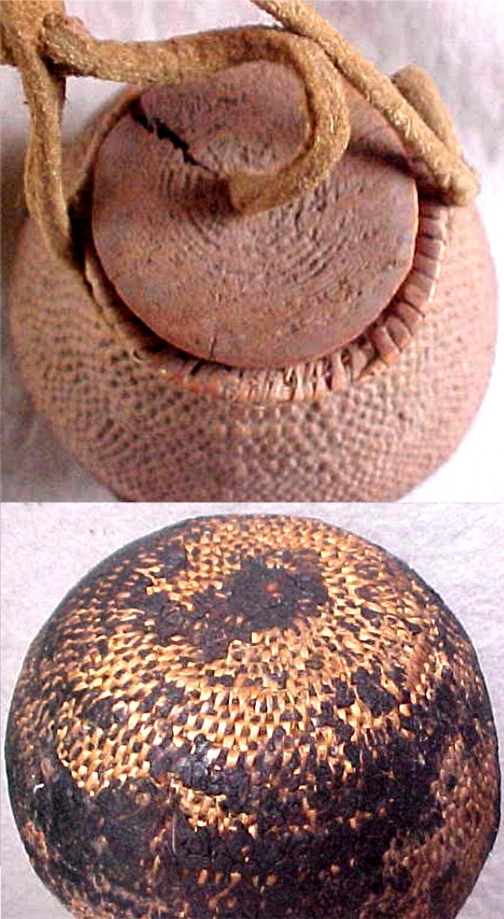
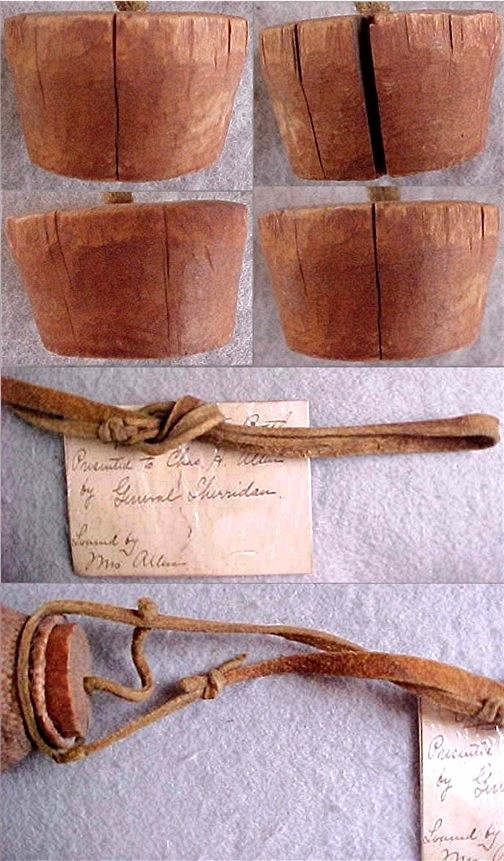
no misshaping. This small olla is fitted with a native
tanned buckskin carrying strap which appears from age
and feel to be original to the olla’s period of use.
The olla’s contents are secured with a hand carved wood
plug which likewise appears to have been fashioned
commensurate with the making of the olla. The plug is
secured to the strap with an extension of the buckskin
strap.
This Apache Olla is an interesting and unique specimen
for several reasons.
A number of these storage jars known as a “tus” /toos/,
are found coated entirely on the exterior and interior
surfaces with pinon pine pitch, which serves to seal the
vessel for carrying water. Those ollas intended to be
used as dry storage such as for seeds and grain were not
sealed with pitch at all, relying only on the tightness
of the weave to protect the contents. This olla is
unusual in that only the bottom half of the exterior of
the vessel is coated with pitch, the majority of which
is still present. While there is no way of determining
why the pitch was applied in this manner with any
certainty, the combination of the small size and partial
coating suggest that whatever this olla was intended to
carry, the owner only carried small amounts of it and he
was concerned that the contents were protected from
moisture rather than containing it. I say “he” because
I suspect this olla was carried by a man traveling from
his home on a hunt or as a member of a war party. Had
it been intended to use exclusively in the home, a
larger size would be more practical and the carrying
strap would not have been necessary.
Tied to the buckskin strap is a handwritten card
measuring 4 ½” by 3”, and inscribed in ink with the
legend:
Apache
Water Bottle
Presented
to Chas. H. Allen
by General
Sheridan
Loaned by
Mrs.
Allen
The card is also annotated “No. 8”, likely an inventory
or accession number. The ink used to inscribe the card
has turned brown, a characteristic change experienced by
old black ink as it exposed to ultraviolet light. The
style of the script is indicative of that used in the
late 19TH and early 20TH Centuries
and the card proper shows age appropriate to the
script. This olla was purchased from a very old
collection which featured a number of 19TH
Century Apache pieces, all exhibiting the same
characteristics of age and patina such as appears on
this piece. The collector admired the Apache culture
and was very selective in his acquisitions. He acquired
this piece with the card attached many years ago in the
northeast United States, not far from the Allen family
home. From the text of the script, one can gather that
Mrs. Allen loaned this olla to an area museum and from
there it passed into the collector market at some point
– not an unusual process as the older museums closed and
their collections were sold.
With so many attractive features, this special Apache
artifact enjoys the added value of being identified to
what is arguably the most influential general of the
Indian Wars and a member of the US Congress who became
well known in his own right during the emergence of the
United States on the world stage. A singularly unique
collectible from a historically important era, this olla
will be an impressive addition to your collection.
(0204) $1675
NOTE:
If you are interested in other Native American
pieces and artifacts related to the American West,
browse through those listings via this link:
CLICK HERE
|