|
MODEL 1836 FLINTLOCK PISTOL – R. JOHNSON, dtd 1844
– WITH BRASS TACKS - SHOWING SOLID EVIDENCE OF USE BY
INDIANS – GREAT WESTERN FRONTIER PISTOL:
Manufactured by Robert Johnson of Middlebury,
Connecticut in 1844, this U.S. Army Model 1836 Pistol
was the pattern carried by the dragoons into the west,
then into Mexico during “Mr. Polk’s War”, and they were
present on many of the Civil War battlefields.
Recognized as one of the most dependable and durable
arms of the period, once they were sold by the army as
obsolete surplus into the post-Civil War civilian
market, they continued to find a ready market among the
Native Americans on the western plains.
Indian used handguns have never been common. Much
scarcer than the Northwest Trade Muskets and other
Indian used long guns, a righteous Indian used pistol is
a special addition to any frontier collection and is
something that appears on the market with far less
frequency than shoulder mounted guns.
Originally produced as a flintlock, the army converted
significant numbers of these Model 1836 Pistols to
percussion in the 1850’s, and the conversions saw
extensive use during the Civil War. In the wake of the
war, revolvers and metallic cartridges eclipsed single
shot muzzle loading pistols in the firearm market, and
yet large companies such as Schuyler, Hartley & Graham
(SH&G) actively bought the Models 1836 and 1842 Pistols
in significant numbers and shipped them to dealers in
the West well into the 1870’s and 1880’s.
SH &G listed the 1836 and 1842 pistols on their invoices
as “Cavalry Pistols”, differentiating between the two
with the notations “iron mounted” or “brass mounted”.
On February 24, 1875, SH&G
delivered 8 cases containing 500 “Cavalry Pistols” to
Ralph & Shrader, a local company engaged to refinish
arms for SH&G, and in less than two weeks Ralph &
Shrader had returned the refurbished pistols to SH&G,
suggesting a element of urgency to prepare those pistols
for the market.
In March of 1876, SH&G included 12 “Cavalry Pistols Iron
Mtd Cal. 54 Refinished” in a shipment which included .50
caliber Trapdoor rifles and Sharps carbines, sent to Max
Meyer & Co. in Omaha, Nebraska.
In October of 1877, SH&G included 2 cases of 100
“Cavalry Pistols 54 Cal” with a shipment of sixty
Remington .50 caliber Carbines to Brownsville, Texas.
In February of 1880, the US Army Ordnance Department
held a sale of “Ordnance and Ordnance Stores” at the New
York Arsenal located on Governor’s Island in New York
Harbor. The catalogue includes a listing for in excess
of 1300 “Smooth Bore Pistols, Altered to percussion,
single barrel, caliber .54”, indicating that these Model
1836 Pistols still had some value on the market as
intact arms, even at this late date.
These are just a few examples of the extent that these
“obsolete” pistols continued to retain their retail
value long after they should have disappeared from the
market. As it is difficult to imagine that even a
recent western-bound immigrant of modest means would
select one of these pistols as his choice for self
defense while the majority of people needing protection
chose metallic cartridge firearms or surplus military
shoulder arms, one is led to believe that the target
consumer group for these pistols was one which was
driven by limited choice, limited access to ammunition,
and limited means with which to pay for them.
Based on the number of these pistols which were shipped
to the western gun dealers, and the number of them that
survive today showing signs of Indian use, it is obvious
they were held in high regard by the Indians who carried
them. The arms adopted by the army in the mid-1800’s –
to include these Model 1836 Pistols - all proved to be
some of the best made of their kind. Earning a solid
reputation in the hands of disciplined soldiers who
observed the norms of care and maintenance, these arms
really proved their durability once they passed into the
surplus civilian market.
For many years students of Indian used guns have noted
the
substantial number of Mississippi Rifles that exist in
private and public collections that show distinct,
classic evidence of Indian use. The Rock Island Arsenal
collection of documented surrendered and captured Indian
guns includes a significant number of Mississippi
Rifles. The Model 1841, or Mississippi Rifle, was a
sturdy, dependable, serviceable firearm, presenting well
with the attractive brass mounts, and it is apparent
that those rifles were a popular and common item of
trade to the Indians. For the same reasons, the
likewise well designed and durable Models 1836 and 1842
Pistols, featuring similarly well made locks and
barrels, and stocked with solid straight grained stocks
which would stand up to heavy use, were recognized by
the Indians as a dependable firearm and a good value on
the traders’ market. Many examples of these arms which
still survive and show evidence of hard use by Indians
obviously were still in active use at the time of their
seizure or collection which testifies to the sturdy
character of these historic arms.
Most certainly, any warrior would be enticed by the
opportunity to acquire a repeater such as a Henry,
Winchester, Spencer, or Whitney-Kennedy, or a metallic
cartridge Colt, Remington or Smith and Wesson, but with
those arms came liabilities that did not attach to the
single shot rifles or pistols. When the mechanics of
the repeating arms needed attention they required
specific parts that were not readily available, and
possibly needed a complete gunsmith shop to affect the
repair. And each of those more modern guns required a
very specific cartridge. While the Indians were very
adept at “making do” by modifying or cannibalizing one
type of cartridge to make cartridges for the gun they
had, that effort still required a steady source of some
kind of fixed ammunition with which to start. Not every
trader carried every type and caliber of ammunition, so
obtaining cartridges was a catch-as-catch-can
situation. On the other hand, almost every trader
carried a supply of lead, percussion caps and powder,
all adaptable to almost any muzzle loading firearm on
the frontier. And too, the number of surviving examples
of repaired firearms that have been credited to Indian
gunsmiths attest to their ability to affect the basic
repairs necessary to keep a muzzle loading firearm in
service.
When viewed in the totality of
the circumstances, it is little wonder that these
“obsolete” arms continued to see effective use on the
frontier in the hands of the Indians.
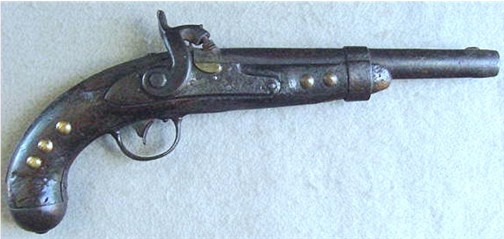
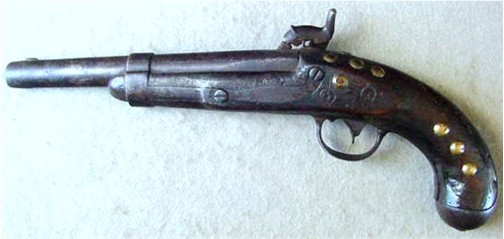
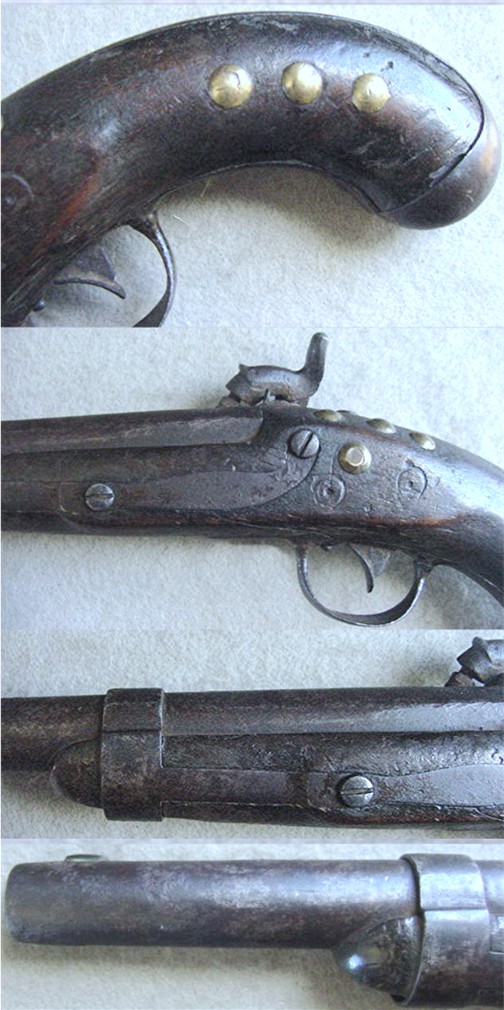
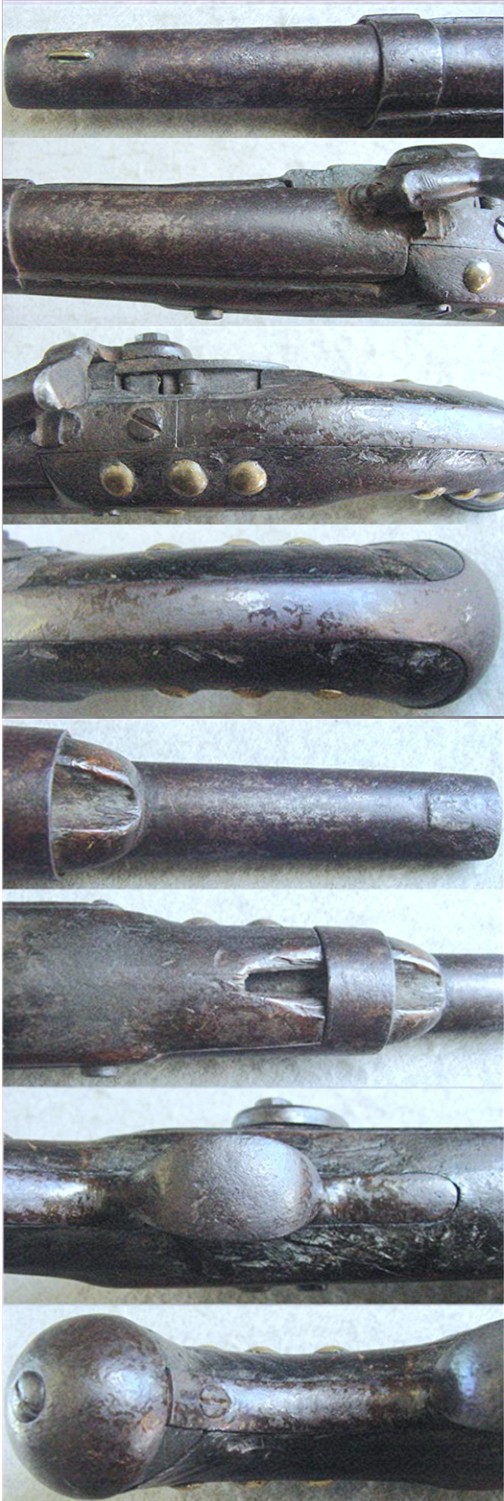
This pistol shows all the appearance of prolonged use
one expects to see on these Indian guns. The exterior
surfaces of the barrel, barrel band, lock, trigger
guard, butt cap, back strap and side plate all have a
naturally aged brown patina. Some of the iron surfaces
retain traces of black paint, a characteristic that John
Dumont noted in his Custer Battle Guns, citing
that a number of Indian used guns have been found that
were painted in dark green, light blue, and black.
The .54 caliber unrifled, smooth bore barrel retains its
original 8 ½” length, the front sight is still present,
and the conversion percussion cone is present and still
retains its shape without being peened over. The bore,
as expected in Indian used guns, shows heavy use, little
care during the period of use, and is pitted for the
full length.
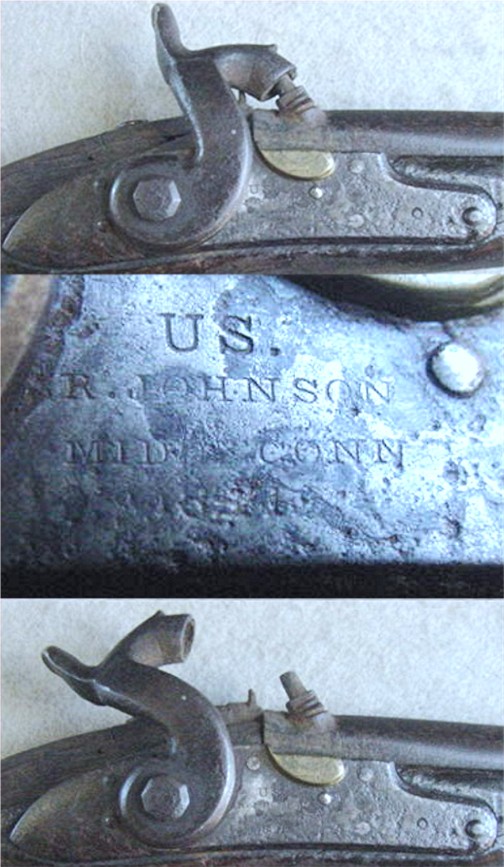
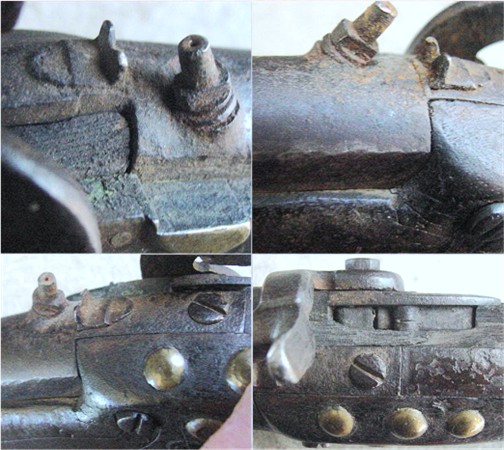
As noted above, the original flint lock hammer and
frizzen were removed during the conversion process, a
percussion hammer was installed and the frizzen pan was
replaced with a brass insert. The lock holds at both
the half cock and full cock positions, and the trigger
release is surprisingly crisp and tight with no wear or
play. The brass insert has a naturally aged, unpolished
pleasing patina. The lock plate still retains a legible
maker’s stamp.
One interesting addition to the pistol is a rear sight
that was mounted on the tang immediately to the rear of
the barrel. The idea that a rear sight would be helpful
on a smooth bore pistol speaks volumes of the optimism
of the man who installed it. As if that weren’t enough,
the view through the rear sight looking down the barrel
is completely blocked by the hammer when the hammer is
at full cock. This leads me to believe that the sight
was installed when this pistol was still in its original
flint lock configuration as the flint cock would not
have angled over the barrel as the percussion hammer
does in order to connect with the percussion cone. When
the conversion was executed and the percussion hammer
was installed, it rendered the rear sight unusable and
leaving it in place required less effort than removing
it.
The swivel mounted ramrod assembly was completely
removed either before it came into the Indians’ hands,
or removed and repurposed by an Indian who considered it
superfluous.
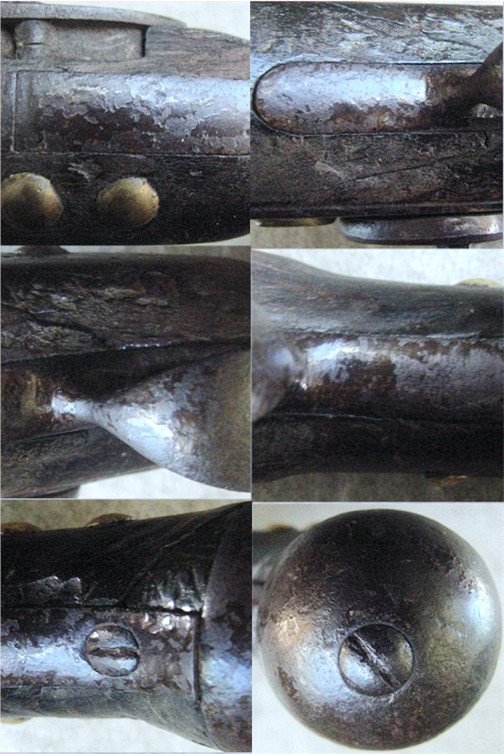
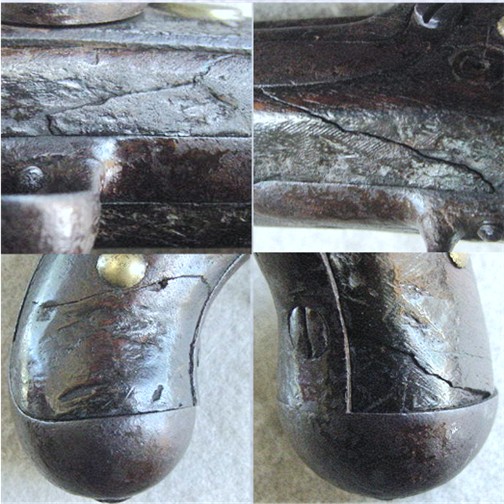
The stock is overall in very solid condition with a rich
deep patina and polished surface attesting to constant
handling and use. There is a crack low on the grip just
above the butt cap, but there is no play or movement, or
any sign of weakness, and the grip is still very solid.
As noted in the above description of the metal, there
are traces of black lacquer paint on some of the wood
surfaces. On the top of the stock, between the lock
plate and the right side of the barrel tang, there is a
section of stock that was broken away long ago during
the period of the pistol’s use. The missing wood in no
way affects the strength of the stock or the lock
mortise, and neither the tang nor the lock plate has any
movement. The exposed grain has been naturally polished
through use and handling, evidence that the pistol
continued to be carried long after the section of wood
was lost.
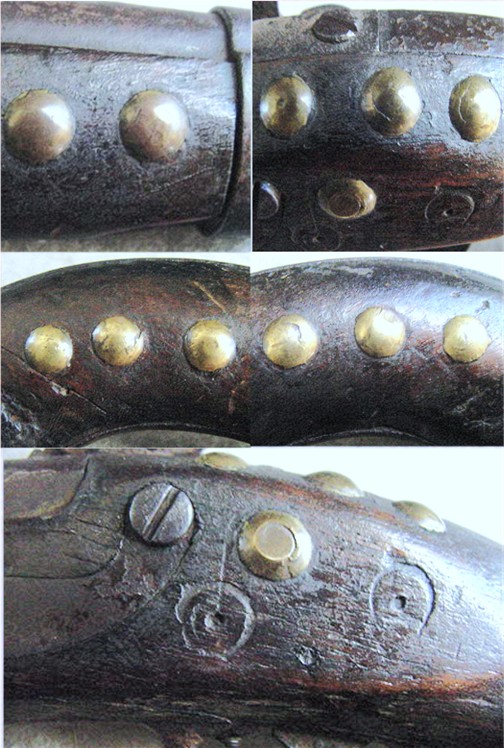
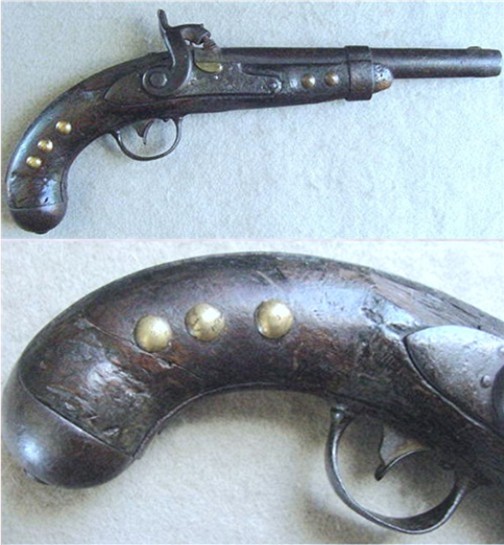
The stock is decorated with tacks distributed along the
right side of the forestock, both sides of the grip, on
the left side of the tang, and on the left flat of the
stock. It is likely tacks also decorated the section of
missing wood described above, and possibly were the
cause of that section of wood breaking away. The tack
heads show appropriate wear, and have the appearance of
having shrunk into the wood, something that only happens
with age and use. There are two tack heads which have
broken away, both on the left flat of the stock. None
of the tacks will attract a magnet, indicating they are
brass shanked tacks. The tacking present on this pistol
not only appears genuine in the type of tacks used, the
appearance of the tack heads, and they way they have
pulled down into the wood grain, but they are also
applied in a manner which is typical of other known
genuine Indian tacked guns, not one of the goofy, humped
up designs applied by modern collectors attempting to
sweeten up an old worn out gun.
Guns that have not been
sullied or ruined by the addition of upholstery tacks,
modern leather wrappings and other enhancements, have
never been common, and as more collectors recognize
their important historic value, Indian guns of this
quality are becoming increasingly difficult to find on
the market. This is an opportunity to obtain an honest
Indian gun that has not been tampered with since the day
it passed from the Indians into that first collection.
This Model 1836 Pistol shows all the classic
characteristics of hard use and decoration in the hands
of an Indian, having a great appearance that literally
talks to you as you hold it, and is no doubt a veteran
of fierce determined and desperate battles, and quite
possibly, untold numbers of buffalo kills in the hands
of a mounted warrior guiding his horse alongside a
running herd.
(0302) $3500
|