|
FLINTLOCK PISTOL MAKER MARKED “CONSTABLE” OF
PHILADELPHIA – VERY ATTRACTIVE EARLY 19TH
CENTURY AMERICAN PISTOL IN ORIGINAL FLINT – EXCELLENT
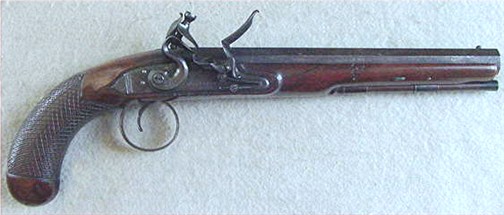
CONDITION: This very attractive single shot
pistol which has survived in its original flintlock
configuration. Based on the years the maker, Richard
Constable, was in business, this pistol dates to the
1815-1830 period. Its overall appearance is in the
style of the pistols produced for the commercial market
which included sales to military officers, private
citizens, and to the fur trade companies operating on
the edges of the North American frontier.
Richard Constable is recorded as being in business as a
gun maker at 88 South 2ND Street,
Philadelphia, Pennsylvania from 1817 to 1851. He was
known to have produced rifles and pistols during the
flintlock and percussion periods, and was particularly
well known for his pistols.
One notable feature of this pistol that needs to be
highlighted is the trigger guard bow, which was made
significantly larger than the standard trigger guards of
this period. This bow will accept two fingers – in the
style of the oversized trigger guard bows on the
Northwest Trade Serpent Side Plate Guns which were
traded to the Indians. The Indians demanded this
feature and the conventional wisdom attributes this
feature to the Indians’ practice of pulling the trigger
with both the index and middle fingers. This one
feature alone does not determine that this pistol was
made for the Indian trade, however enlarged trigger
guards on pistols which do show use by Indians exist and
are known – I own three of them which were modified
during the period of their use to incorporate these
larger trigger guards. These pistols are far from
common, and if I didn’t already have the examples I do,
this pistol would never see the light of day. While the
condition of this pistol indicates it was never traded
to an Indian, it is entirely possible Constable made
this pistol with the Indian fur trade in mind.
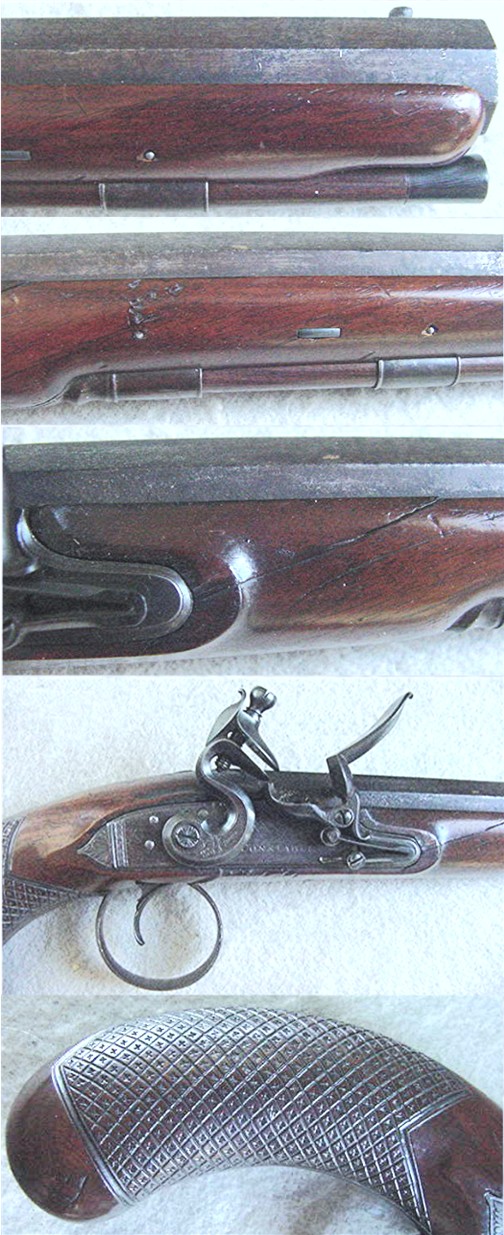
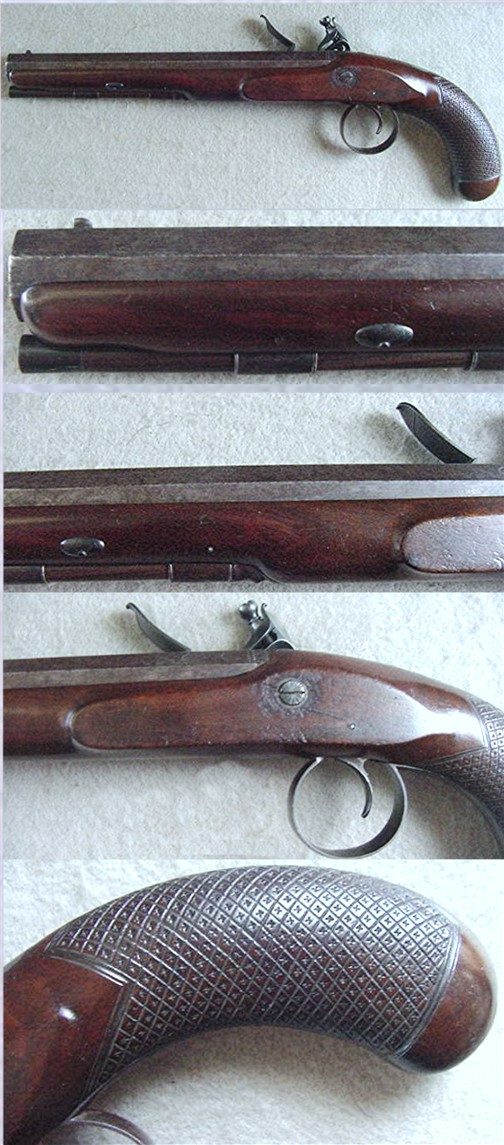
Measuring 14 ½” in overall length, the pistol is mounted
with a 9” long .64 caliber barrel. The barrel finished
with an engraved breech plug and the octagon profile is
full form with no misshaping or damage on the outer
surface. There is no pitting on the outer surface and
it appears that the barrel still retains a considerable
amount of its original finish. The barrel has a front
sight only - a simple iron post, and no rear sight. The
bore is not rifled, is overall smooth, with only minimal
patches of very light pitting. The barrel bears the two
English Birmingham Proof Stamps used by private
contractors prior to 1813. A large number of English
made gun parts, including barrels, continued to be
imported into the United States and used by American
gunmakers, and the absence of the “LONDON” stamp on the
top of the barrel argues for this pistol having been
made in the United States. Constable is known to have
imported firearms and gun parts from England.
The flint lock is fully functional, the hammer holds at
both the half and full cock positions and the trigger
let off is very crisp. The plate, hammer and hammer
screw are lightly engraved and the lock retains the
majority of what appears to be the original finish.
The stock is full form with no loss along the edges of
the barrel channel. The surface of the wood shows the
expected handling marks, but no significant dents or
disfigurement and the original finish is still intact
over the majority of the surface. The grip is checkered
with a single wrap-around panel, featuring a bold
diamond pattern with a pip in the center of each
diamond. The checkering has survived with distinct
diamonds that show no wear. There are two age checks in
the stock – one is a short age crack on the left side of
the stock running the short space between the lock screw
washer and the barrel channel, hardly noticeable and no
doubt stable. The second runs from the forward trigger
guard finial, up the right side of the stock to the
right side edge of the barrel channel. The check has
not separated, nor does it show any signs of affecting
the integrity of the stock.
The trigger guard, ramrod thimbles and lock screw washer
are all made of steel, and there is a silver escutcheon
oval inlay on the top of the wrist. The front finial of
the trigger guard is finished in the shape of a
pineapple, and the bow and pineapple finial of the
trigger guard, and the ramrod entry pipe are all treated
with nicely engraved details. The ramrod is fitted with
a horn tip and it appears to be original to the pistol.
This is a very attractive, early
manufacture, American made pistol which has survived in
overall excellent condition and it incorporates some
very interesting features. This would be a special
addition to your early Western Frontier collection.
(0719) $2,500
|