|
CIVIL WAR CAVALRY OFFICERS LIGHT CAVALRY SABRE –
BEAUTIFULLY ETCHED BLADE AND FINE ENGRAVED FITTINGS ON
THE SCABBARD – A VERY IMPRESSIVE SPECIMEN: This
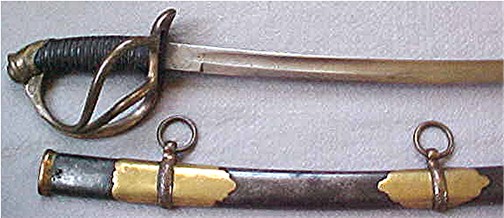
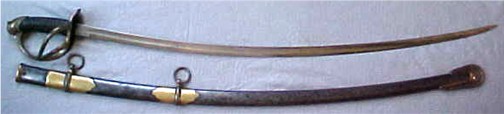
Civil War Cavalry Officers Light Cavalry Sabre with it’s
beautifully etched blade and finely engraved scabbard
fittings is destined to be the centerpiece of your
cavalry sabre collection. At best, Cavalry Officer’s
sabres of this quality have always been difficult to
find offered on the market for they were simply not
produced in great quantity. One estimate determined
that one of the largest manufacturers of cavalry sabres,
the Ames Company, manufactured only 338 Cavalry Officers
sabres, a mere 4/10ths of one percent of their total
cavalry sabre production. In addition, not all Cavalry
Officers sabres were embellished to the degree present
on this specimen. Cost, personal finances, and
availability all served to limit many of the officers’
sabres to plain, unadorned scabbards, blades with very
simple etching or no etching at all, and little
decoration on the guard.
This
particular sabre was featured, and pictured in
photographs, in an article written by Stephen Dorsey in
a 1992 issue of Gun Report magazine entitled
"Variations of The Civil War Cavalry Officers' Sabres".
Although this sabre is unmarked, the features including
the style of the fittings and the pattern of the
decorations, reinforce it’s identification as being made
by Henry Sauerbier of Newark, New Jersey.
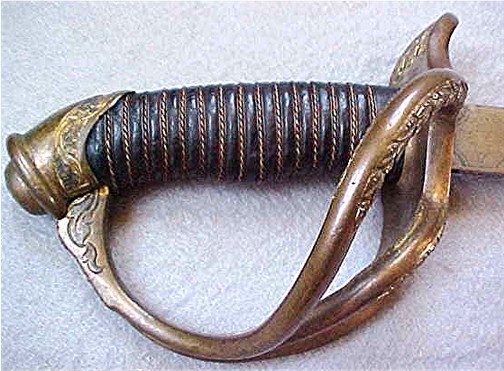
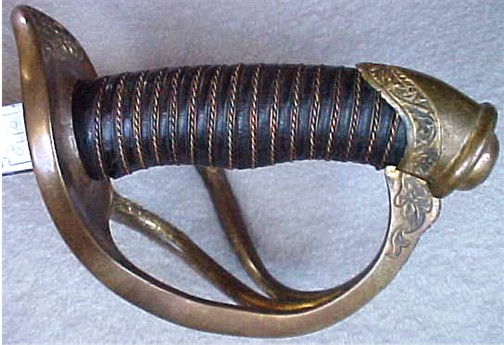
The unmarked
blade is consistent with Sauerbier’s sabres. The
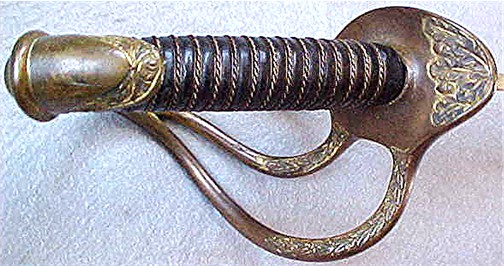
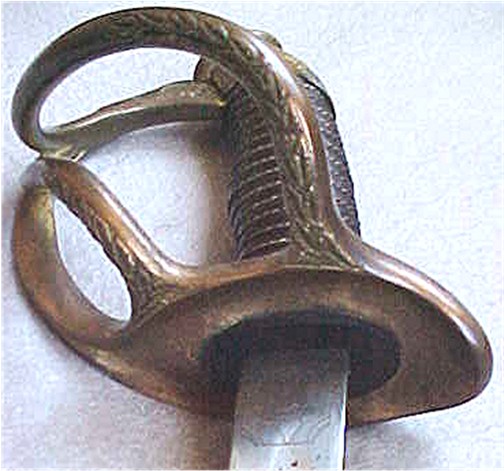
Phyrgian cap pommel, the three branches of the guard and
the quillon all feature the cast decorations of acanthus
leaves and berries and/or oak leaves and acorns. The
decoration on the quillon is further enhanced with hand
applied chasings to emphasize the relief of the leaves.
The guard is full form with no damage and the branches
maintain their original curve. The classic light
cavalry sabre grip with the swelled belly is covered in
black leather secured with a three strand-twisted center
wire wrapping. The leather is overall smooth showing no
wear or flaking and the wire is tight in the grooves of
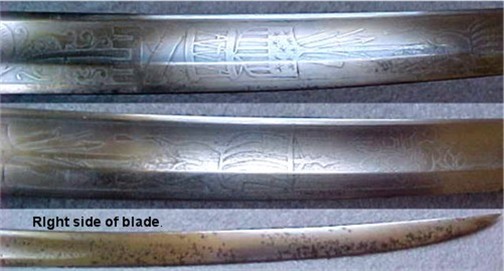
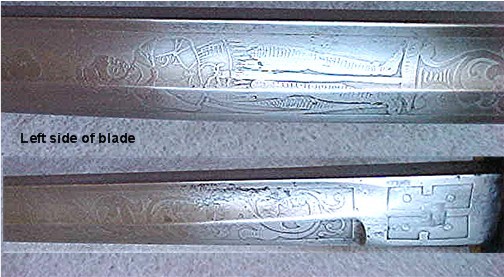
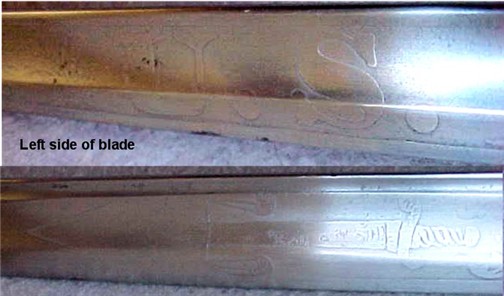
the grip. The blade is full length, features an
unstopped fuller, again consistent with Sauerbier
sabres, and is finely etched on both sides with a
variety of floral and military motif patterns. The
obverse (right) side of the blade is etched over half
the length of the blade beginning at the guard with a
floral pattern, then a stand of arms surmounted by an
American Flag, then a spread winged Federal eagle over a
banner, terminating in more floral work. The reverse
(left) side of the blade is likewise etched for over
half the length of the blade, beginning at the guard
with floral patterns, then a classic figure of an
armored soldier, then a bold “US”, a Roman short sword,
and finishing in more floral patterns. The etchings are
all clear and legible, however they are almost
impossible to photograph and capture the etched images
due to the glare from the blade. The blade has a flat
back, unstopped fuller and is unsharpened with a smooth
edge with only one minor nick, terminating in the
original shape of the point. The blade is overall
bright with only scattered minor darkening on the last
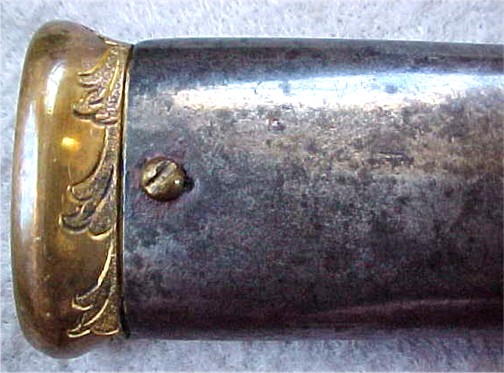
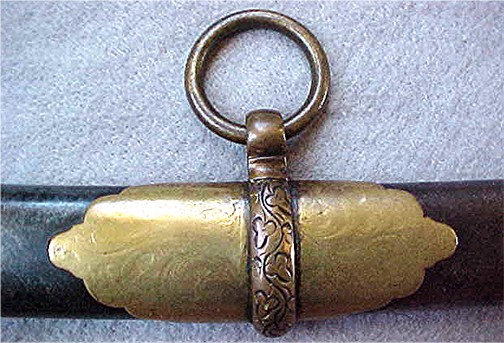
four inches of the blade. The steel scabbard is very
attractive with a smooth, even blued surface with a nice
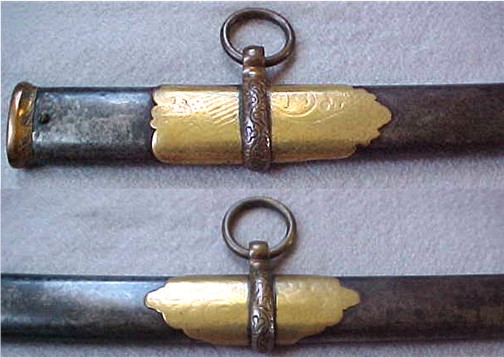
mottled, aged finish. The brass throat is decorated on
both sides with a deeply engraved leaf pattern. The
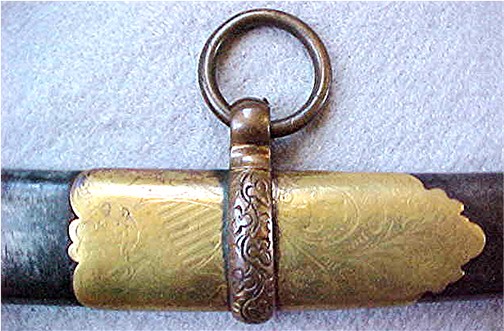
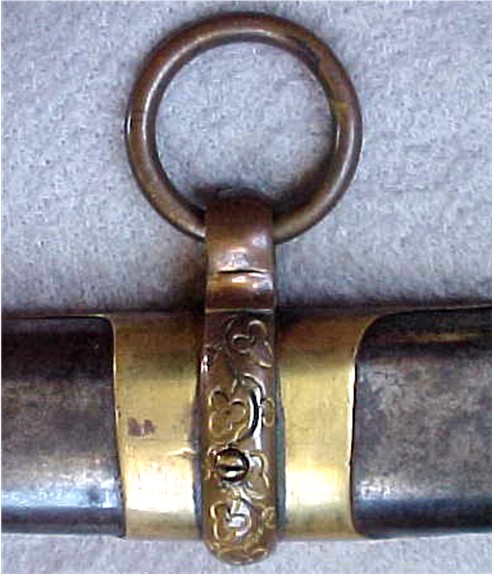
broad bands under the ring mounts are consistent with
those used on known Sauerbier scabbards and make a
dramatic presentation on this scabbard, engraved with a
leaf pattern overall, with a stand of arms behind a
federal shield on the top portion of the upper band.
The ring mounts have the cast leaf decoration on both
sides and both rings are intact and retain their shape.
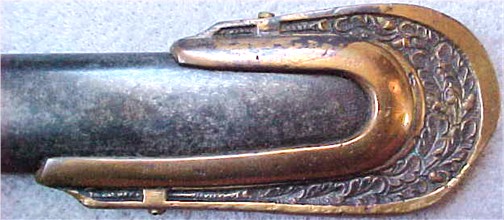
The scabbard body is full form with no dents and a
complete, intact seam. The drag is one of the more
decorative styles used by Sauerbier with the oak leaf
and acorn decoration on both sides.
This Cavalry Officer’s Sabre is an elegant piece
and it will provide the owner with a great sense of
pride in ownership. These heavily decorated sabres
seldom see the light of day, quietly passing from one
collection to the next with few opportunities to acquire
one.
SOLD
|