|
KNIGHTS OF THE GOLDEN CIRCLE McCLELLAN SADDLE – A
VERY RARE ARTIFACT FROM A FASCINATING YET RELATIVELY
UNKNOWN CHAPTER OF AMERICAN HISTORY OF THE SOUTH, THE
CONFEDERACY, AND THE RECONSTRUCTION ERA:
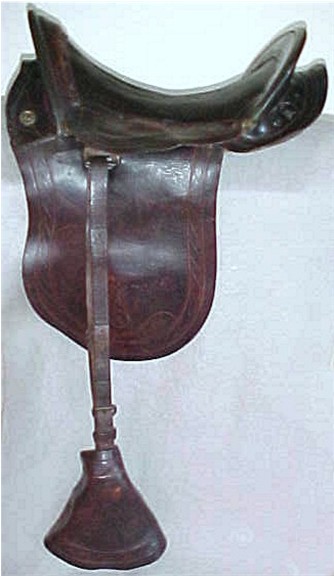
This beautiful McClellan
style mid-19TH Century saddle survives as an
artifact from a chapter of American history with which
relatively few people are familiar. Purchased some
years ago from a northeast Texas estate, this saddle
includes many features which would have appealed to a
man of some means. Of particular note, the saddle is
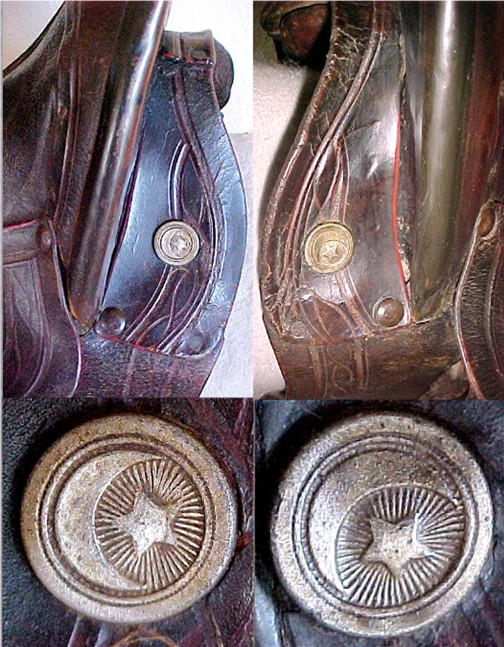
adorned with two 1” diameter silver metal medallions –
one on each side of the pommel – bearing identical “star
and crescent” designs which strongly suggest this saddle
was owned by a member of the Knights of the Golden
Circle (KGC).
In 1861, an anonymous author wrote in An Authentic
Exposition of the K.G.C., Knights of the Golden Circle
the following description of KGC symbols on display in
an KGC “castle”, as the organization’s local meeting
halls were known:
“The symbols were a large bronzed crescent, or new
moon, set with fifteen stars… The crescent represents
the growing Southern Confederacy; …..its glowing sun and
fifteen stars foreshadows the benign influence of a
fully matured Southern Government extending its borders
through Cuba, Mexico, and Central and South America….”
As with any attempt to excerpt a
period or event in history, choosing where to start and
what to include in a necessarily limited space presents
a definite challenge, and so it is with this effort to
recount the history of the Knights of the Golden Circle
(KGC).
As early as the mid-19TH Century, the
difference between the future economic prospects of the
northern states versus those in the south were becoming
very apparent. While the industrial north was able to
increase its wealth with the same capital investments
employed today – modernizing equipment, increasing the
trained workforce, building additional factories, etc. –
the only means of increasing wealth in the primarily
agrarian south – the same solution in use today on
modern farms - was the acquisition of more land.
Beginning with the Act Prohibiting Importation of
Slaves, passed by Congress in 1807, expansion or growth
of the slave based economy of the south was restricted
by ever increasing limitations imposed by several
legislations up through the Kansas-Nebraska Act of 1854.
The origins of the KGC has been traced back to the
pre-secession sentiments raised in South Carolina in the
1830’s which called for the dissolution of the United
States and the establishment of a Southern Empire. The
most commonly accepted references characterize the KGC
as a militant pro-slavery, pro-secession movement which
called for the creation of a geographic “Golden Circle”
– an independent political and economic zone which would
include the southern and border states, Mexico, Central
America and Cuba. This “circular” Southern Empire, with
a radius of some 1,200 miles extending from Havana
through the Gulf of Mexico and the Caribbean, would be a
slave-based, agrarian society of plantations producing
cotton, tobacco, sugar, indigo, and coffee to fuel the
economy. The proponents believed this empire would
attract European investment and foresaw the creation of
mines, an extensive rail network, and the development of
manufacturing centers.
The Knights of the Golden Circle is considered by many
scholars to be the most powerful secret and subversive
organization in the history of the United States,
recruiting members from every state – north and south -
and territory by the end of the Civil War. In order to
maintain this veil of secrecy, the members were sworn to
blood oaths, and virtually no written records survived,
instead they relied heavily on a system of symbols and
recognition signs to identify fellow members - hence the
decorations on horse equipment and arms such as these
examples:
Decorative medallions, like those which are present on
this saddle, are seldom encountered on McClellan
saddles. However, as more pieces with identical or
similar decorations came to light, I began to fully
appreciate the historical significance of the design,
and understand how wide spread the use of these emblems
were on the horse equipment and weapons used by members
of the Knights of the Golden Circle.
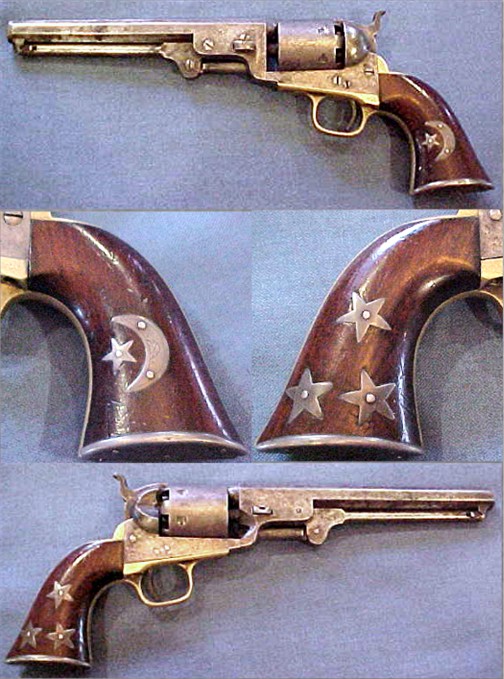
Some time after acquiring this saddle, I was shown this
Colt Model 1851 Navy Pistol which had been purchased
from a family estate east of Corpus Christi, Texas. The
grip is decorated with an inlaid silver star and
crescent design on one side and three silver stars on
the other. At the time the pistol was purchased, the
family members told the buyer that the original owner of
the pistol had served in the Confederate Army, had been
a member of the Knights of the Golden Circle, and he had
the grips decorated to indicate his membership in the
organization. Knowing about the medallions on my
saddle, the new owner of this pistol shared the
information regarding the connection between the
decorations on grips and the original owner’s
affiliation with the KGC.
Collecting has a serendipitous
nature, and so after I acquired this saddle and viewed
the Colt Navy, I was contacted by a couple in Vermont
who in the course of building collection of antique
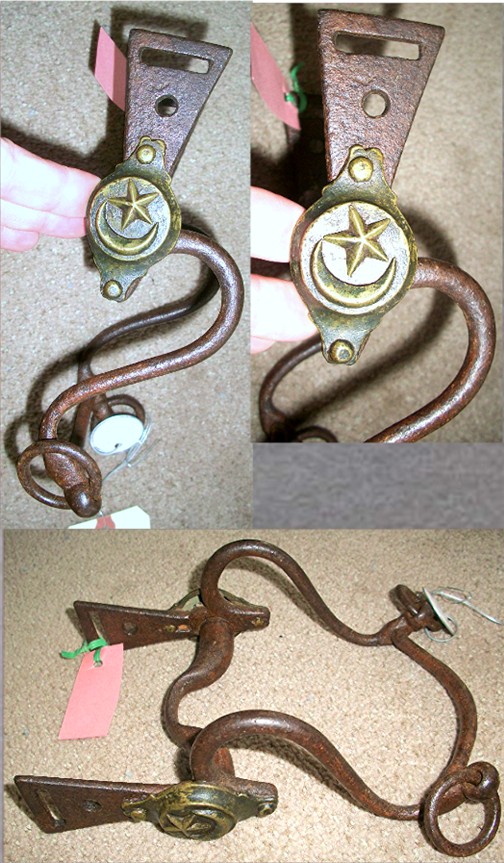
bridle bits, purchased a mid-19th Century
European bit decorated with brass medallions bearing the
same star and crescent design as the medallions on this
saddle. The importation of horse equipment from Europe
was not unusual during the 1800’s, especially during our
Civil War and in particular by the Confederacy. While
the bit did not have any provenance or history attached
to it, having studied the horse equipment of the period
I am certain the bit is genuine and it dates to the
Civil War era, and that the medallions date to the
period of the bit’s use.
Offered at auction some years ago
was a hard used Civil War era musket decorated similarly
to the Colt Navy described above, with a silver crescent
and star inletted into the butt stock.
In another auction during this same time frame, a Morgan
Muley Saddle bearing the star and crescent medallions
identical to those on the saddle offered here was
offered as part of an identified Texas Confederate
cavalryman's grouping. In addition to the provenance,
the Morgan saddle was fitted with a pair of the iron
“Star Tread” stirrups that have been associated with
Civil War Texas cavalry units.
Worthy of mention is a famous portrait of Mexican War
hero Major General John A. Quitman (later governor of
Mississippi) depicting the general astride his horse
during the Mexican War which shows a five pointed star
above a crescent moon on the rear corner of his saddle
cloth. Quitman was an ardent supporter of the planned
expansion of the South into Cuba and Central America,
and was very active in the hierarchy of the KGC, so his
display of these KGC emblems was certainly more than
coincidence.
Viewing these artifacts within the context of what is
known of the symbolism of the KGC, coupled with the
history of those items that can be dated or identified,
these pieces offer compelling evidence that the
distinctive star and crescent moon decorations were
applied by members who wished to covertly identify
themselves to brother members within an otherwise
clandestine organization. Other than the pieces
described here, I have not seen any other similarly
decorated pieces for sale. It is of little surprise
that KGC associated pieces are seldom encountered in the
market. Frankly, I don't think many of them survived,
and if they did, it stands to reason that many of them
are still being held by the descendants of the original
KGC members.
Early 1860 newspapers across the country reported that
the Knights of the Golden Circle were recruiting troops
in numerous cities to send to Brownsville, Texas, for
the planned invasion of Mexico, however the civil war
looming on the horizon may have caused the KGC leaders
to reconsider, and the invasion never took place. The
KGC held a convention in Raleigh, North Carolina, from
May 7–11, 1860, and reported a total membership of
48,000 men from the north in addition to those members
in the south, and an army of "less than 14,000 men".
According to other authoritative reports, by late 1860
the KGC could call on 100,000 trained and armed men.
Even before the Civil War began, Texas was the greatest
source of the organization's membership, being home to
at least thirty-two KGC “castles” in twenty-seven
counties, including the towns of San Antonio, Marshall,
Canton, and Castroville. Evidence suggests that San
Antonio may have served as the organization’s national
headquarters for a time. Before the Civil War’s opening
shots were fired on Ft. Sumter on April 12, 1861, and
before Texas held its referendum on secession on
February 23, 1861, Texas volunteer forces, which
included one hundred fifty KGC soldiers under the
command of Col. Ben McCulloch, forced the surrender of
the federal arsenal at San Antonio on February 15, 1861.
KGC troops were also instrumental in gaining the
surrender of many of the federal military posts between
San Antonio and El Paso.
The KGC fully supported Confederate States of America
and placed its military ranks at the disposal of the
Confederate States Army. KGC members acted as
emissaries who negotiated treaties with Indian tribes on
the western frontier, organized regular army regiments
as well as bands of irregulars such as Quantrill’s
Guerillas, and perhaps most significantly began an
organized subversive effort to undermine the war
capabilities of the North, to include establishing an
espionage network. These clandestine missions were well
suited to the secretive nature of the KGC, and resulted
in attracting the attention of the U.S. War Department’s
anti-espionage efforts.
In October 1864 U. S. Judge Advocate Joseph Holt
submitted a detailed report, warning Secretary of War
Edwin Stanton of the dangers posed by the KGC, however
Holt’s report fell far short of defining the full scope,
intent and financial resources of the organization. It
was far larger and more capable than the federal
government could imagine. Beginning in 1861, President
Lincoln received repeated written warnings regarding the
extent of the threat posed by the KGC, not only to the
US government, but to the President’s personal safety –
concerns that ultimately proved to be genuine.
Some historians credit the KGC with organizing the
bloody anti-draft riots in New York City in July, 1863.
Although the riots did not reach the desired goal of
ending the draft and thereby limiting the North’s
ability to maintain their manpower in the field, this
failure did factor into what would become a radical
change of focus for the organization. Coupled with the
defeats at Vicksburg and Gettysburg that same month, the
KGC reached the conclusion that the Confederacy could
not prevail in the conflict. With these devastating
defeats, any chance that the British or the French would
intervene on behalf of the South disappeared, and
without European assistance, many believed the South had
insufficient capital, material and troops to prosecute
the war.
It was during that summer that the leadership of the KGC
focused its attention on the future, fiercely determined
that the American south would somehow, someday, prove
victorious in a Second War of Rebellion. By the end of
that year, the organization was taken completely
underground, concentrating their efforts towards putting
into place an ingenious network of caches of arms and
money, much of it stolen from the U.S. Government. This
enormous enterprise was carried out under a veil of
strictest secrecy and it all but escaped scrutiny.
With the fall of the Confederacy, the leadership of the
KGC disbursed to Canada, England, Cuba, and Mexico, as
well as throughout the Old Confederacy and into the
western territories and states. As a viable
organization, the KGC continued to pursue their goals
for many decades, in ways even more secretive than ever
before, with the notable exception of two notorious
individuals who left their unforgettable marks on the
history of the United States.
A considerable number of
well known historic figures have been associated with
the KGC - such easily recognizable names as John Wilkes
Booth, John C. Calhoun, Jefferson Davis, Nathan Bedford
Forrest, Jesse James, Frank James, Ben McCulloch, John
Hunt Morgan, William Quantrill, John Surratt – names
readily connected with the Confederacy. However, two of
these names in particular stand apart, and through the
years have continued to fuel virtually unlimited
speculation - those of John
Wilkes Booth and Jesse James.
From period accounts that exist, it appears that Booth
was indeed a member of the KGC. Perhaps the best
account can be drawn from The Private Journal and
Diary of John H. Surratt, The Conspirator, written
by Surratt, edited by Dion Haco, and published by
Frederic A. Brady of New York in 1866. Surratt
provides great detail when describing how he was
introduced to the KGC in the summer of 1860 by another
Knight, John Wilkes Booth, and inducted into this
mysterious organization on July 2, 1860, at a castle in
Baltimore, Maryland. Surratt describes the elaborate,
secretive induction ceremony, detailing the rituals, and
stating that cabinet members, congressmen, judges,
editors, actors, prize fighters, and known criminals
were in attendance. One of the most significant claims
made by Surratt in his diary is that the KGC began
plotting to kidnap Abraham Lincoln in 1860, before
Lincoln was even inaugurated in 1861, and that they
continued to foment these plans throughout the Civil
War. While Booth’s membership in the KGC is well
established, how much direct support the KGC provided to
Booth when he assassinated President Lincoln still
remains in question, primarily due to the lack of any
surviving written records.
It has been argued that the infamous James Brothers –
Jesse and Frank - were not the outlaws history has
described them to be, but rather they were employees and
zealous members of the KGC. Both of these sons of
Missouri were veteran members of William Quantrill’s
guerillas – a unit known to wear crescent moon & star
shaped lapel pins on the upturned brims of their hats,
suggesting more than a casual association with the KGC.
Within months of the end of the War, Cole Younger
led a group of former Quantrill’s men who robbed the
Clay County Savings Association in Liberty, Missouri,
netting some $70,000 in cash, gold and bonds and
establishing a pattern of raids and robberies which
would plague the Trans-Mississippi region for years to
come. As with Younger, Jesse James emerged from the War
with a specific skill set which led to him becoming
arguably the most famous post-Civil War outlaw.
Described in one source as “the KGC’s master field
commander”, a credible argument has been made that Jesse
James was not a predatory outlaw out for personal gain,
but rather was an ardent member of the KGC who was
committing the robberies to fund the Second Southern
Rebellion. When one considers the impressive amount of
treasure reported lost in the robberies attributed to
James and his various gangs, it is impossible to ignore
that he never displayed any unexplained appreciable
wealth. So, where did the money go? In recent years
the answer to this question has emerged as historians
have identified, searched for, and in some cases,
located caches of treasure buried by these post-war KGC
Knights within a well designed and coded system of
vaults. While the ongoing story of this treasure is
well beyond the scope of this description, it is well
worth the telling. I encourage you to obtain a copy of
Rebel Gold by Warren Getler and Bob Brewer, a
compelling account of the KGC and its post Civil War
buried treasure. Without the authors’ detailed research
and easy to read style of writing, I would have been at
a loss in writing this description.
According to most authorities, the KGC ceased operations
by 1916 – perhaps due to the United States’ entry into
World War I. And too, with the passage of time, most of
the old Knights of the Golden Circle had died, and with
them, their dreams of an independent Southern Empire.
This saddle is of the style of other known private
purchase saddles, acquired by officers, and in some
cases enlisted men, with their own funds as opposed to
those saddles issued by the armies. Since the McClellan
was the standard pattern of the period, many of these
private purchase saddles followed the same design with
some additional embellishments, determined by the
financial ability of the purchaser. Of particular note
on this saddle are the two 1” diameter silver colored
medallions – one on each side of the pommel – which bear
identical “star and crescent” designs.
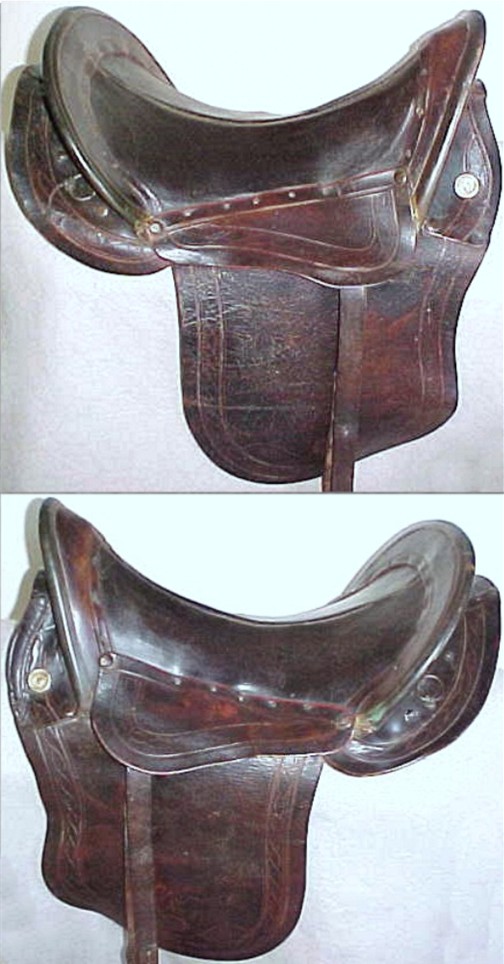
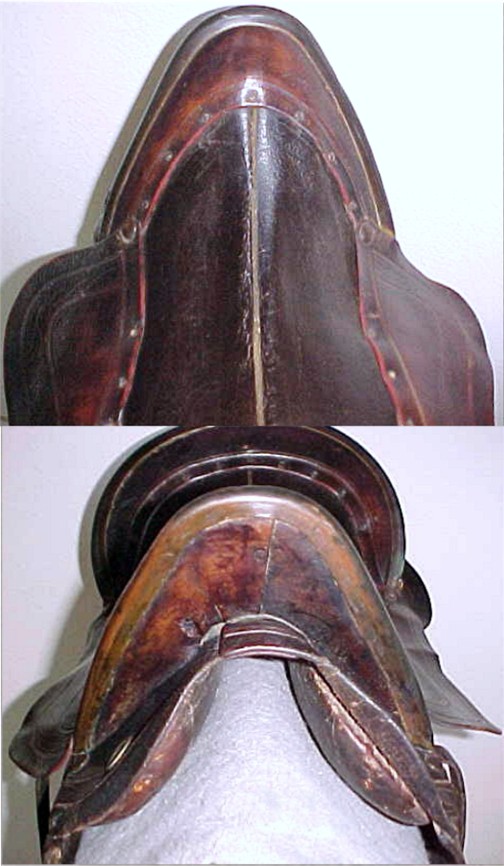
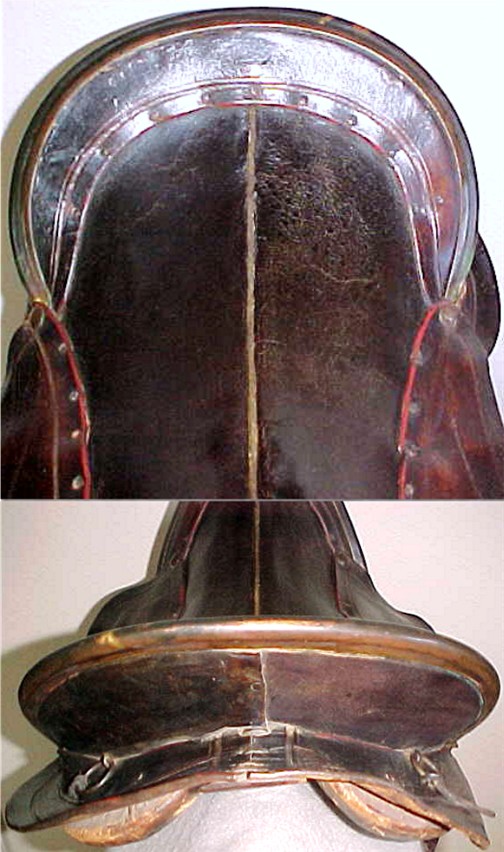
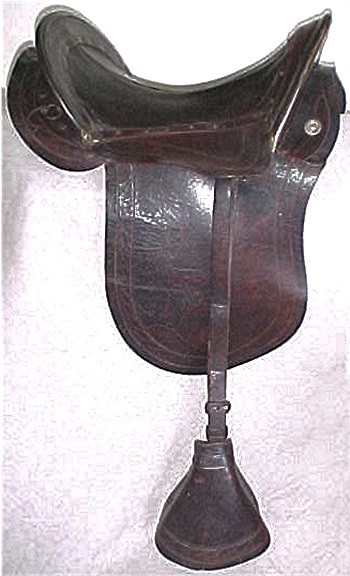
This saddle is a classic Civil War era Officer’s
McClellan Saddle. Manufactured by an unknown maker, the
saddle features the high quality work, special features,
and design of the saddles the officers of both sides of
the conflict special ordered and paid for from their own
funds. The short skirting forward of the pommel and
behind the cantle, and the short “jocky’s” – the short
skirts on each side of the seat, the decorative carving
and stamped borders, and the red highlights – all attest
that this saddle was made for a man of some financial
means, able to afford these added, and expensive,
touches.
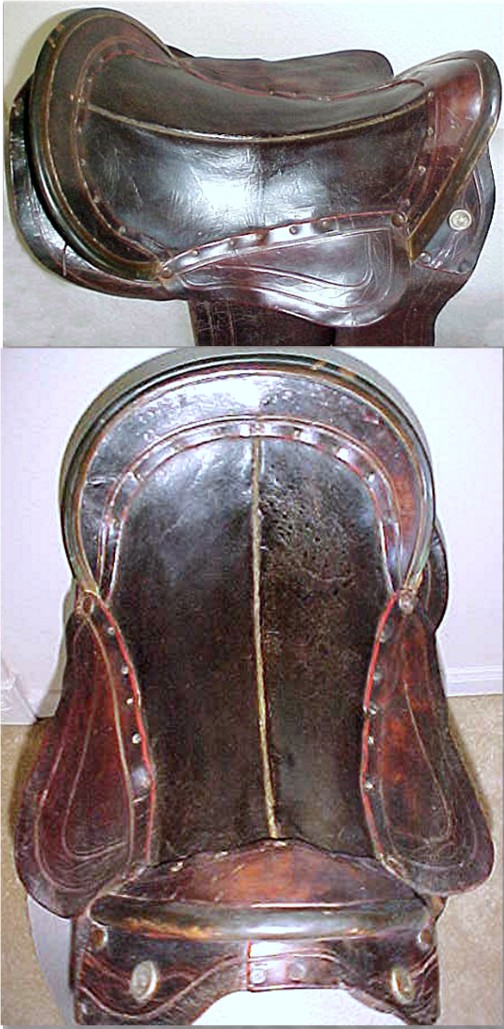
A finishing touch, the crests of the pommel and cantle
retain the original brass molding, another extra that
would have added to the cost of the saddle, and a very
desirable feature when grading Civil War era officer’s
saddles. The brass has aged evenly and now has a dark
patina.
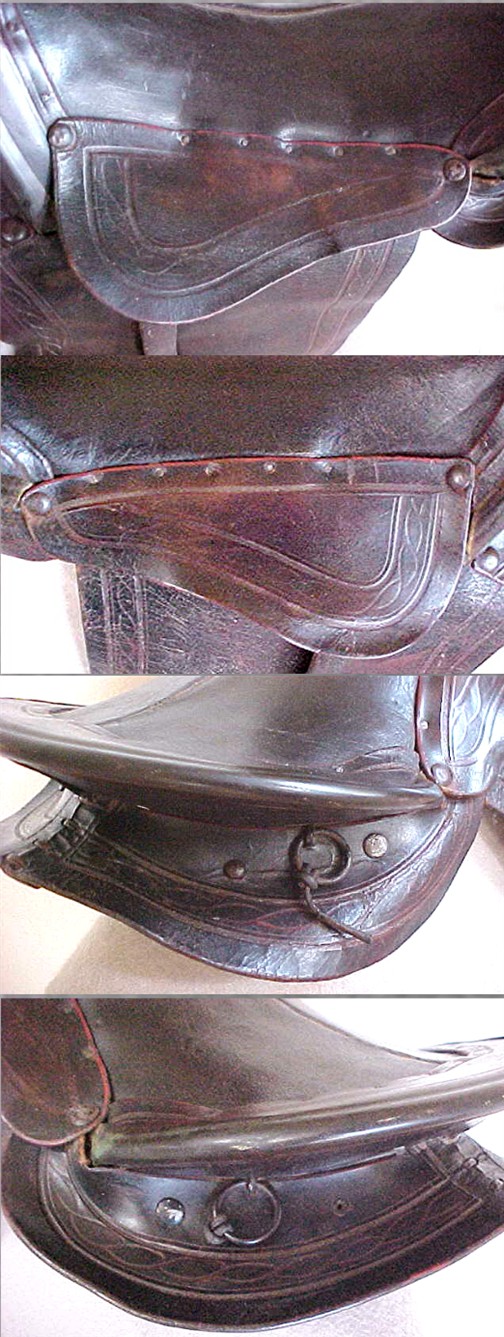
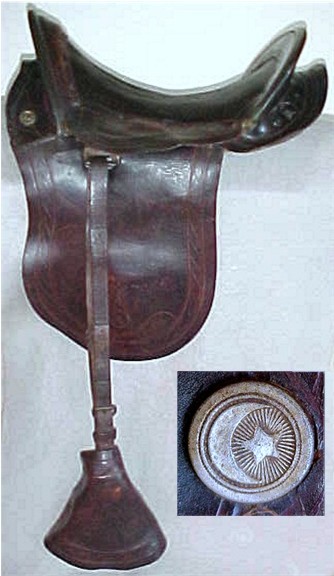
Highlighting the saddle are the two matching silver
colored metal medallions – one on each side of the
saddle, attached to the skirting immediately in front of
the pommel. The medallions feature the crescent moon
and star in high relief, with light radiating from
behind the star. Both medallions are firmly attached
and are in excellent condition with no damage, defacing
or misshaping.
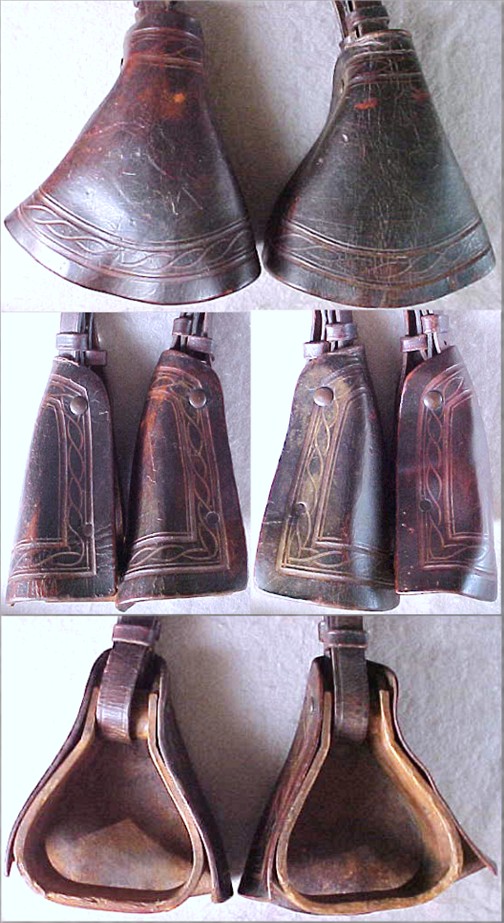
The fully leather covered seat, pommel, cantle, side bar
extensions, skirts and stirrup hoods are all made of a
reddish-brown leather featuring stamped and hand carved
designs. The black leather suspended seat – a feature
surviving from the saddle designs popular in the
antebellum years – contrasts nicely with the brown
finish on the balance of the saddle. The edges of the
brown leather are highlighted with red lacquer enamel
paint, much of this trim surviving with a vibrant
color. The combinations of brown and black leather, and
the red lacquer trim, are all characteristics that have
been noted on a number of high grade saddles produced
for senior ranking officers of the period. While red is
often associated with the artillery, in fact it was
commonly used by senior officers of all the branches, to
the point that some officers elected to ride saddles
made entirely of bright red leather – a fashion
statement, if you will, of the period.
The saddle is in excellent condition with a bright,
shiny surface to the leather throughout, with no
significant wear or damage, and no missing components.
Both the outer and inner skirts are full form and
intact, and both girth straps are present under each of
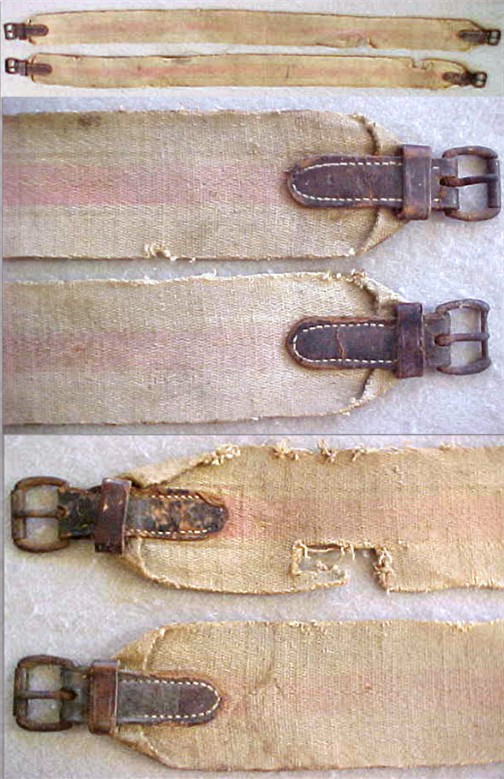
the skirts. The original stirrup straps, stirrups and
both linen girths survived with the saddle – an unusual
added value as in many cases, these components were
separated from the officer’s saddles and lost through
the years. The saddle is fitted with equipment rings
on both of the rear extension of the sidebars, a
standard feature on saddles intended for extended travel
away from the rider’s home base, another indicator this
saddle was used by a man in military service.
I am aware of two other Civil War period saddles which
bear the same medallions as appear on this saddle – a
total of only three. In light of the literally
thousands of 19TH Century American military
saddles I have examined in the course of building my own
collection, research I did for The American Military
Saddle 1776-1945, appraising saddles in other
collections, and conducting consulting work for museums
and auction houses, I find it remarkable that only three
bearing this same symbol have been noted. For what it
is worth, over the course of the sixty years he spent
studying antique militaria, my co-author - who had a
particular interest in the Confederacy, and was
descended from a Confederate Missouri cavalryman - had
never seen one of these saddles prior to my acquisition
of this specimen. This low number of specimens speaks
volumes as to the rarity of these Knights of the Golden
Circle saddles. It is quite likely you will never have
the opportunity to buy another.
Civil War officer’s saddles in comparable condition, but
lacking any specific historical association, command a
premium on the market in their own right. They survive
in much lower numbers than do the saddles of the rank
and file, and due to the manner in which they were
constructed – lighter weight leather, carving and
stamping which weakened the leather, etc. – they seldom
survive in decent condition. This saddle is not only an
attractive specimen; it is in excellent condition and
most importantly, enjoys the confirmed association with
the Knights of the Golden Circle, making it a
significantly historic saddle. (0509) $5500
NOTE:
This offering is for the saddle only - the
Colt Navy and the bit are not included in the sale.
|