|
WORLD WAR ONE MODEL 1910 MILLS ENLISTED MEDICAL
CORPSMAN’S BELT – RIMMED EAGLE SNAPS - COMPLETE w/ THE
RARE CONTENTS AND APPENDAGES – AN EXCELLENT SPECIMEN:
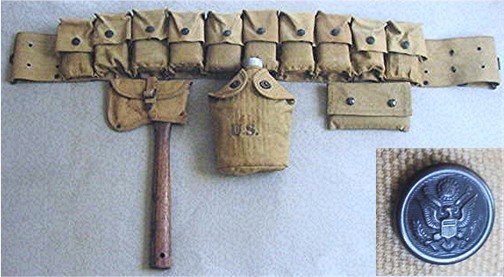
A rare offering, this excellent Mills Rimmed Eagle Snap
Model 1910 Enlisted Man’s Medical Belt is in excellent
condition and is outfitted with the special medical
equipment and supplies that were originally carried in
the belt by the medical corpsmen in the field as they
accompanied the troops. One of the widest of the Mills
belts, the belt was designed to bear the additional
weight of a full load of medical supplies, a hand
hatchet, and at least one canteen – on occasion the
medic would carry a second, adding appreciably to the
total weight.
  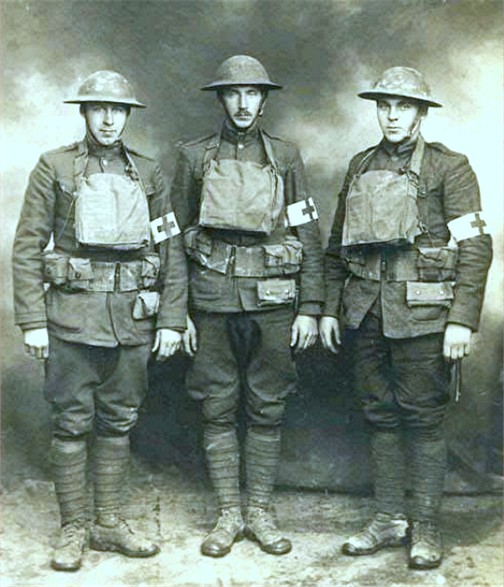
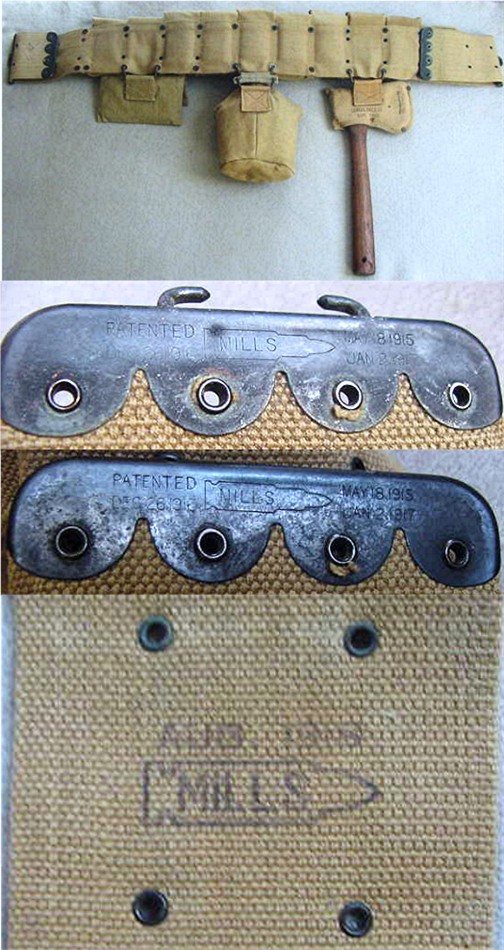
The belt proper is complete with all the eyelets and
closures which still retain the original blackened
finish, the eagle snaps are all present, retain their
subdued finish and all function properly with no
fasteners pulled loose from the woven material. The
belt shows no wear or damage and all of the edges are
still crisp. The belt body is ink stamped “AUG 1918”
and both of the blackened belt tips still bear the
legible Mills Company patent and logo stampings.
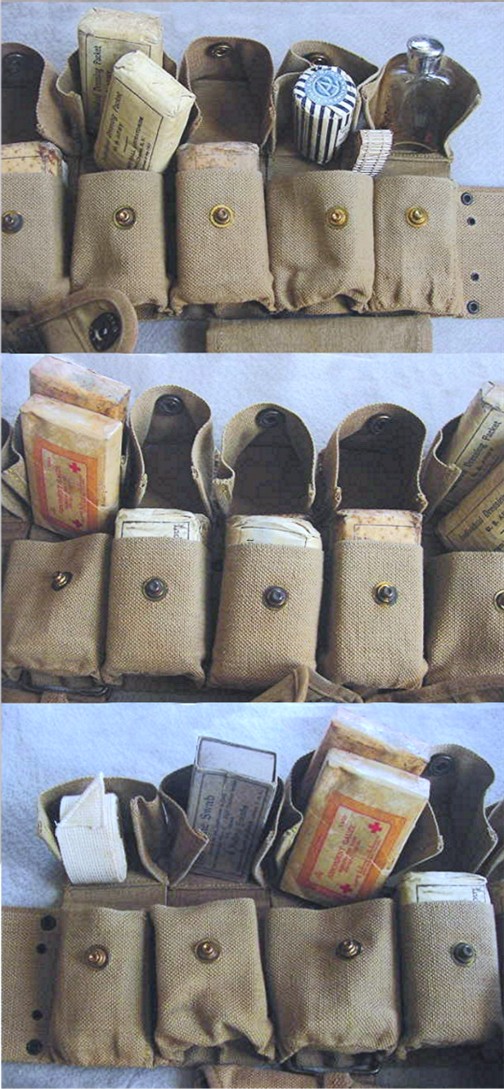
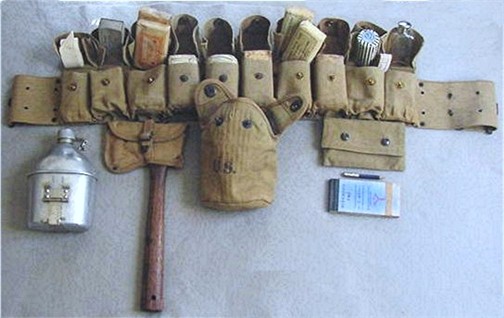
The equipment and the contents of the 10 pockets are
described here – in the same order as they were in the
“Manual for the Medical Department, 1916” - beginning
with the left front pouch, “Number 1”, and around the
belt to the right front pouch, “Number 10”:
No. 1: This pocket (and likewise pocket
No. 10) is half the depth of pockets No. 2 through 9,
and features a divider, creating a smaller pocket on
front interior face of the pocket. The main pocket
compartment contains a Field Tourniquet in “like new”
condition showing no signs of use.
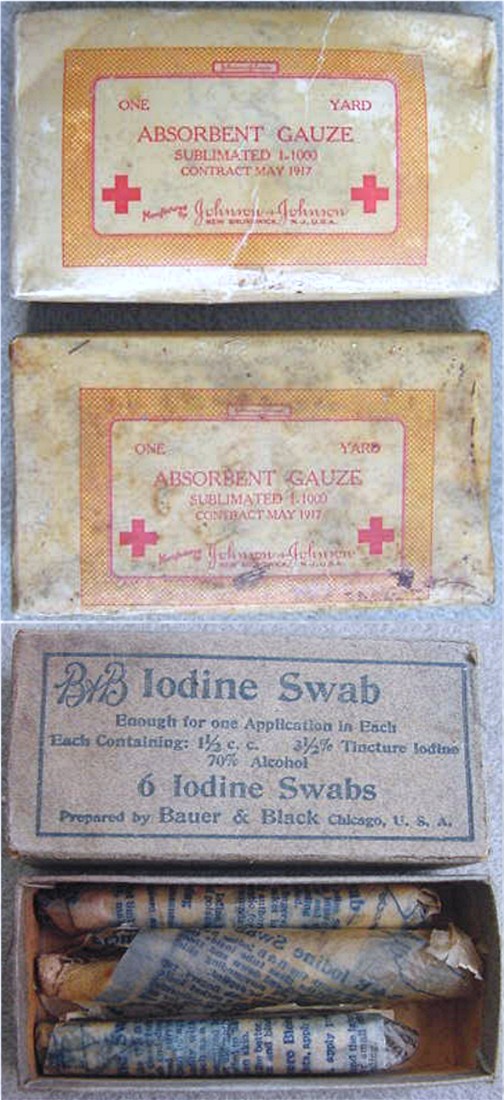
No. 2: This pocket contains one box of
Iodine Swabs, produced by the Bauer & Black Company.
One of the most difficult components of this belt to
find, this box is in full form with no separations or
tears, has a fully legible label and still contains
three of the original iodine swabs, wrapped in the
original waxed paper wrappers with the printed
instructions.
No. 3: This pocket contains two Corrosive
Sublimated Gauze Bandages, each compressed in a waxed
box. These bandages were used to allow the wound to
drain, and retard the onset of infection. Both packets,
produced by Johnson & Johnson, are still sealed, are in
full form, and have fully legible labels bearing the May
of 1917 contract dates. One packet is very clean and
the other shows some minor surface soiling from having
been issued and carried, but it is still sealed and
retains its form.
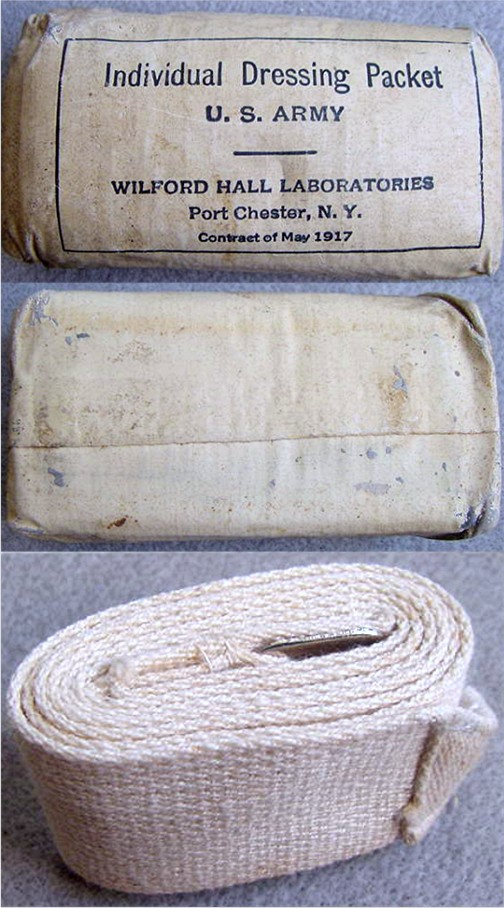
No.’s 4 through 8: These five pockets
contain the Individual Dressing Packets – two in each
pocket. All ten dressing packets are original World War
One issue, each bearing fully legible labels – six
produced by Wilford Hall (all dated 1917), two by Bauer
& Black (both dated 1917), and two by Seabury & Johnson
(both dated 1918). Some of the packets present in
excellent condition, others show some storage or pocket
wear with some soiling, but all are in full form, still
sealed, and with complete wrappers with no tearing.
These dressing packets were manufactured with white
oilcloth wrappers and were intended exclusively for
issue with this belt, as opposed to the dressings
encased in the brass tins issued to the individual
soldiers. Eliminating the metal tins served to reduce
the overall weight of the belt. As the oil cloth
wrappers were more inclined to aging and wear and tear
through the years, these packets survive in lower
numbers than those in the brass tins, so this full
complement of dressings as they present in this belt are
a real added value.
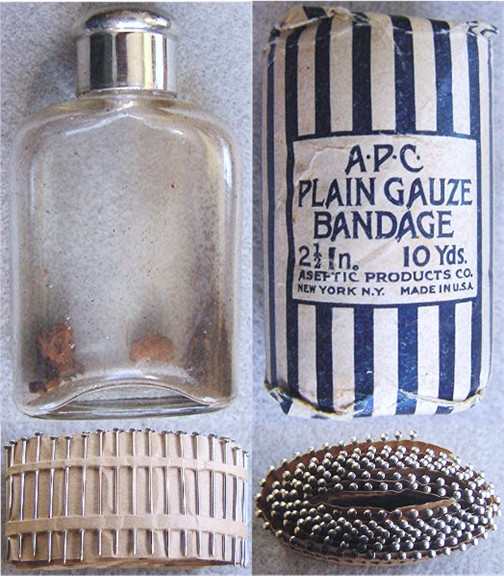
No. 9: This pocket contains one roll of
period correct APC Plain Gauze Bandage, 2 ½” wide and 10
yards long. The roll is completely covered in the
original paper wrapper, presents in excellent condition
with both ends sealed, and a fully legible label.
This pocket also contains the paper of straight pins
which were used to secure bandages in place once applied
to the wound. This paper of pins was intended to be
carried in the front compartment of Pocket No. 10,
however it is a tight fit and to prevent unnecessary
wear to the pins or compartment, I’ve placed them in
this pocket No. 9.
No. 10: This pocket contains the clear
glass flask with a nickeled screw top. The screw top
still retains the cork washer and the remnants of the
rubber stopper are in the bottle – which dried out
through the years and crumbled. The glass is full form
with no chips or cracks.
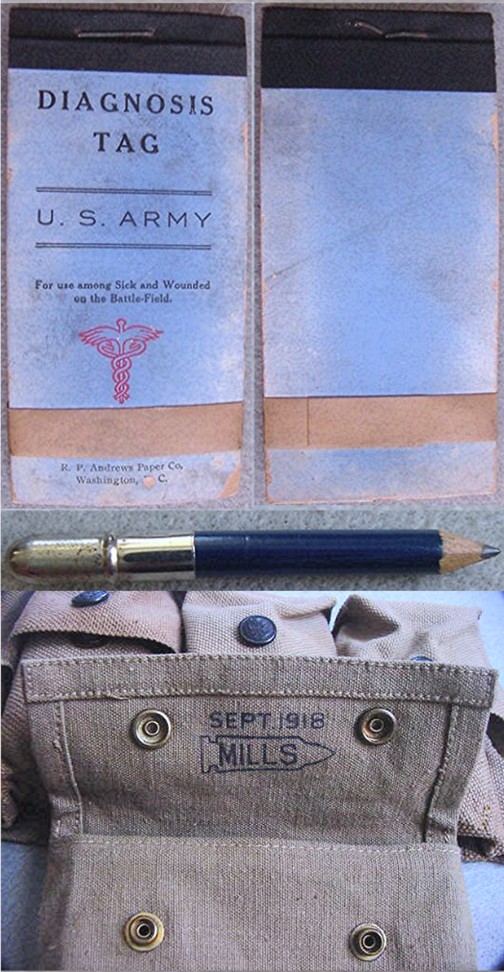
Model 1910 Diagnostic Tag Pouch: Mounted
on the right front lower edge of the belt, this Model
1910 Diagnostic Tag Booklet Pouch matches the same
excellent condition as the belt. The snaps retain their
original blackened finish and are fully functional with
no wear or tearing. The inside of the pouch flap is ink
stamped “SEPT 1918” with the Mills in the Bullet logo.
The pouch contains the original Diagnostic Tag Booklet.
This booklet has never been opened or used, still
retaining the khaki colored paper band applied by the
printer to keep the pages secured until the booklet was
issued. As the booklet remains sealed, it retains all
of the Duplicate Diagnostic Forms - one of which was
intended to be left with each wounded soldier to detail
his wounds and the treatment he had received to that
point. The pad is in full form, with the only sign of
aging being some minor fading to the blue color of the
covers. The front labeling is in excellent condition
and fully legible. These pads are quite rare today and
a pad in any condition is hard to find, and this pad is
an excellent, unused specimen - a very necessary
component to complete this belt. The pad is
accompanied by an excellent unused original pencil with
the nickeled metal cap as was issued with these belts.
These pencils are very rare and seldom survive with
these belts.
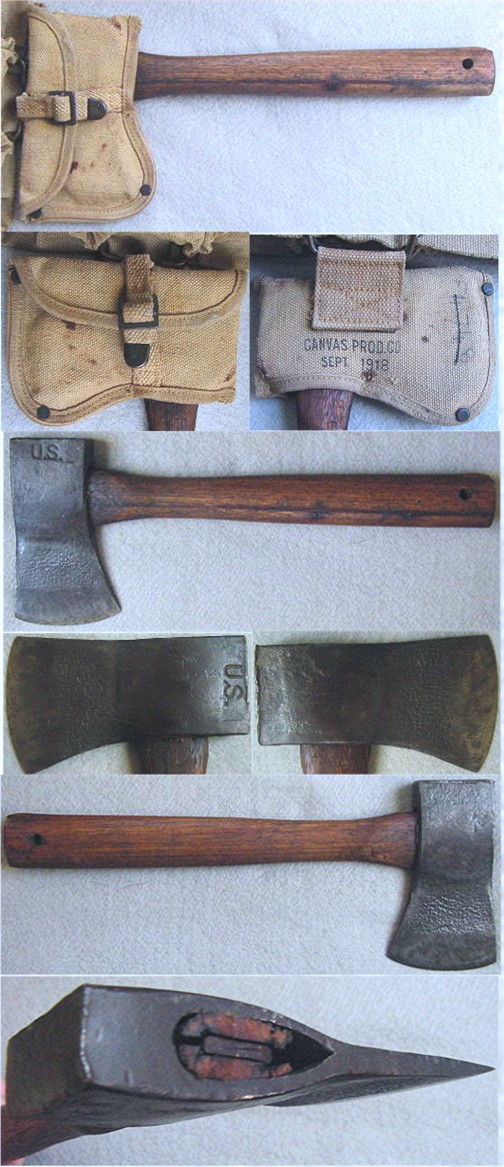
Model 1910 Hatchet and Hatchet Carrier:
Full form and in very good condition, this Model 1910
Hatchet shows little use. The hatchet head is stamped
“US”, and has not suffered from corrosion nor has it
been heavily sharpened. The woven canvas carrier is ink
stamped by the manufacturer, “CANVAS PROD CO.” and “SEPT
1918”. The exterior and interior of the carrier bears
“4748”, written in ink – perhaps the last four numerals
of the soldier to whom the hatchet was issued. The
carrier is full form with a fully intact and functional
closure strap and buckle. The canvas shows some sign of
soiling and some minor wear caused by the corners of the
hatchet head, but the cover is still intact and retains
its integrity. The hatchet handle is full form and
length with some minor loss inside the eye of the head,
but the handle is still solidly attached to the head
with no looseness. Overall this is a very good
specimen.
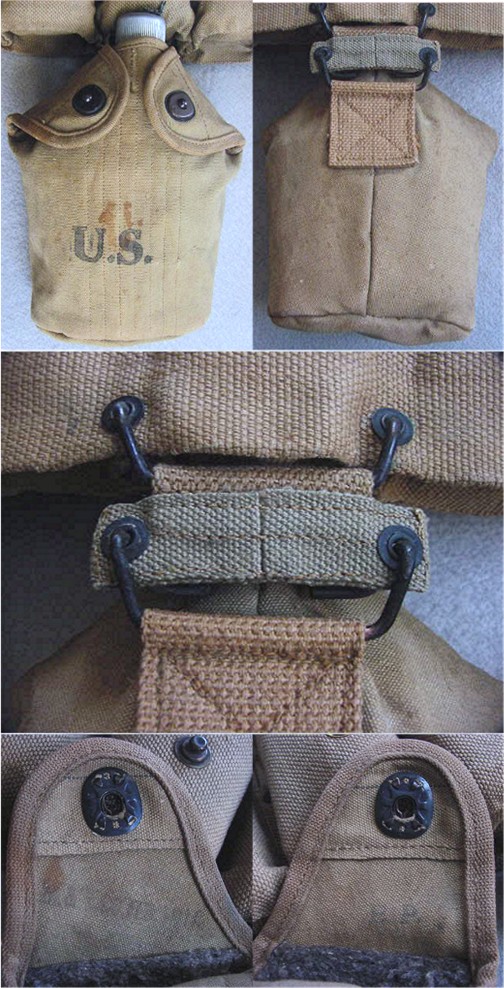
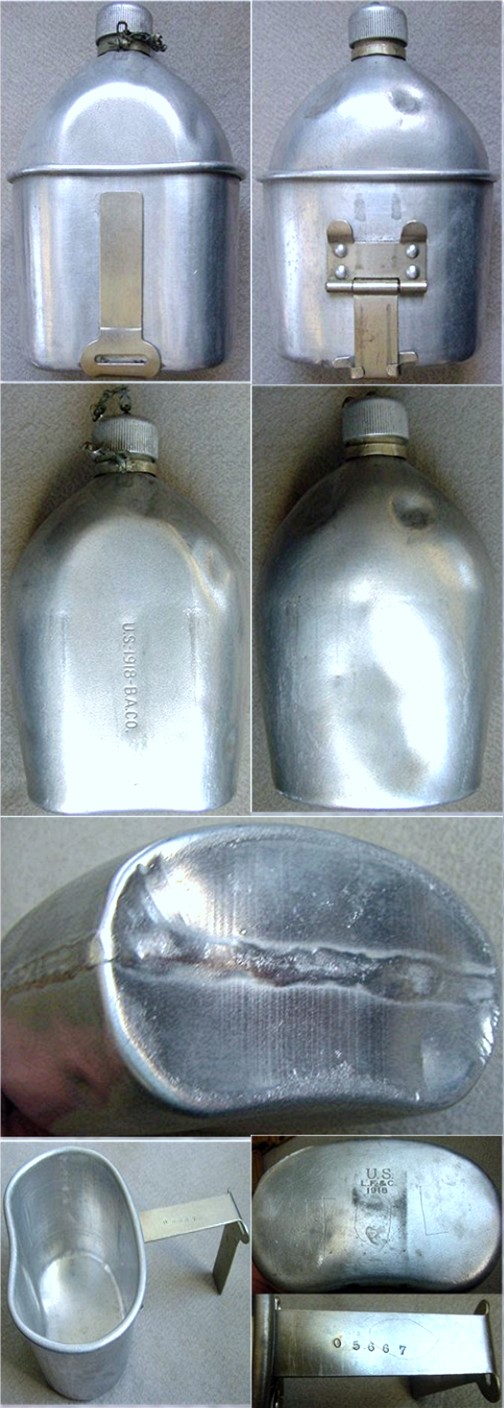
Model 1910 Canteen: This complete Model
1910 Canteen features a very good cover with a fully
legible “U.S.”, the maker’s ink stamp under the left
flap – “M & H Co.” and the date “FEB 1916(?)”, and the
inspector’s stamp under the right flap “E.P.”. There is
a minor stain on the front but the cover is overall
clean with no wear spots. All the seams are fully
intact and the lift the dot snaps still retain their
original blackened finish, both are complete, function
well and show no signs of tearing around the snaps as is
often the case.
The canteen and cup are both full form with no
significant dents and no cracks or other defects and the
handle on the cup functions properly. The canteen is
maker marked “US 1918 BA CO.” and the cup is marked “US
L.F. & C.1918”. The handle of the cup is stamped with a
five digit number which may have been the soldier’s
service number.
Mills Medical Belt Canteen Extension Hanger:
A rare component of these Medical Belts, this Mills
Extension Hanger dropped the canteen below the bottom
edge of the pockets and allowed the canteen to hang
freely without binding against the belt. In full form
and in excellent condition, this extension shows no
wear.
This Model 1910 Enlisted Medical
Corpsman’s Belt is in excellent condition, and makes for
an impressive addition to any World War One equipment or
medical display. Complete with the majority of the
correct and necessary medical equipment and supplies,
including several of the rarest and almost impossible to
find items, this is a remarkable specimen. To find such
a belt of this quality with the contents intact is
becoming increasingly difficult and this specimen is
worthy of adding to most collections. This is the
quality of belt that often moves quietly from one
collection to the next with never seeing the light of
day. (1002) $2450
|