|
TRANTER FIREARMS COMPANY MILLING TOOL BITS – FROM
THE RESEARCH COLLECTION OF DOUGLAS NIE – WELL KNOWN
AUTHORITY ON TRANTER ARMS:
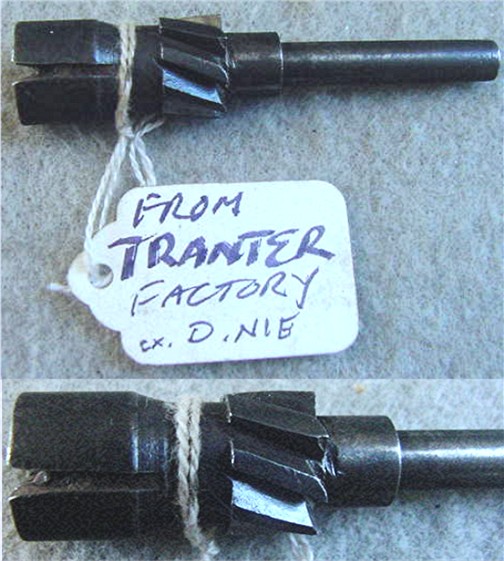
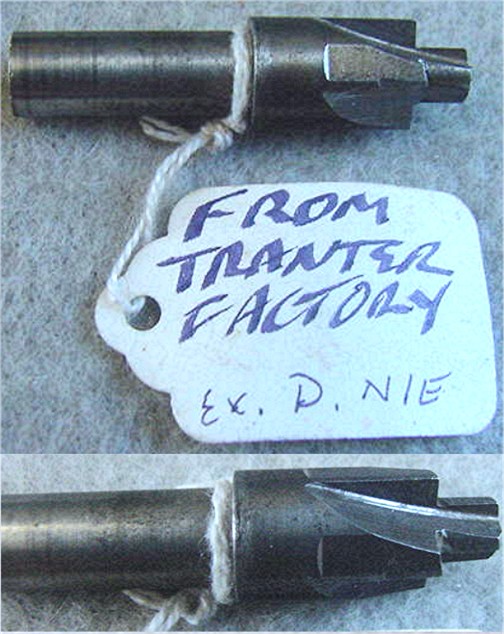
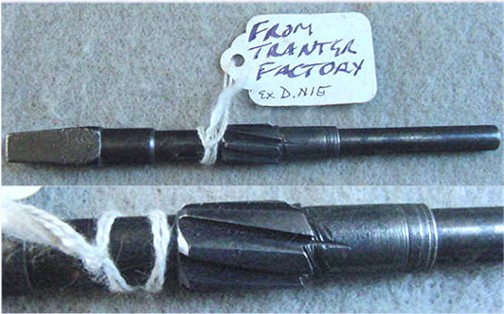
These three milling bits,
identified as having come from the Tranter Firearms
Company factory in Birmingham, England, were acquired
from the collection of Douglas Nie, a noted and well
respected authority on the subject of Tranter Firearms.

WILLIAM
TRANTER
William Tranter, born in 1816 near
Birmingham, England, was the eldest son of Thomas
Tranter, a blacksmith. In 1830 at the age of 14, William
was apprenticed to the gunsmithing firm of Hollis
Brothers & Co. in Birmingham. In 1839, he left Hollis
Brothers and purchased the gun shop of Robert Dugard at
29.5 Whittall Street, Birmingham with a small
inheritance left to him by an uncle. An
advertisement published in 1841 indicates the business
was well established:
"William
Tranter (successor to R. Dugard), Gun and Pistol maker,
for home and exportation, No. 29.5
Whittall Street, Birmingham. Percussion caps, waddings,
implements, barrels,
locks, and furniture of every description."
Tranter remained at the Whittall
Street address until 1849 and during those years he
established partnerships with his old employer Hollis
Brothers & Co. at 10-11 Weaman Row between 1844 and
1849, and with Isaac Brentnall Sheath from 1845.
By 1851 Tranter's factory
was located in the heart of Birmingham's Gun Quarter at
13 St Mary's Row and he maintained additional shops,
sheds, steam machinery, yard and premises at 50 Loveday
Street between 1854 and 1860.
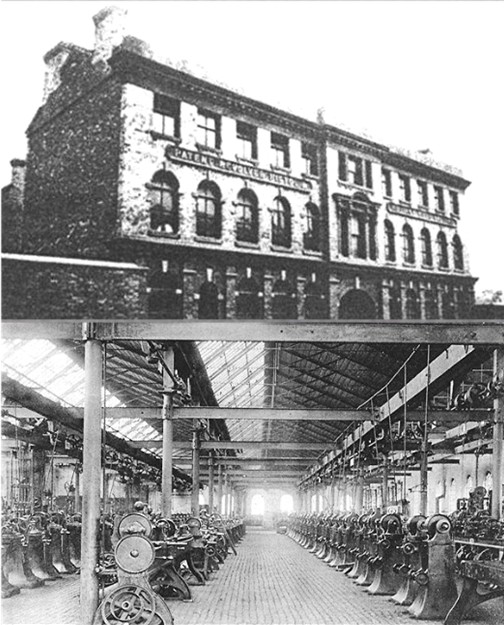
TRANTER
FIREARMS FACTORY
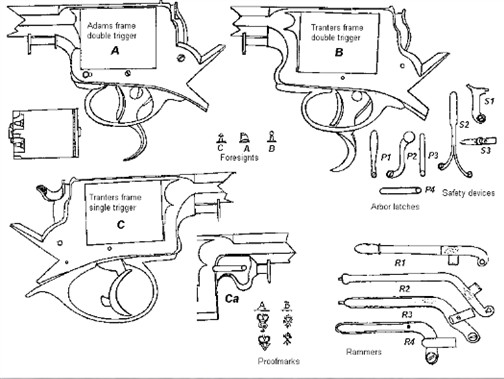
By 1853 it is believed he had manufactured over 8000
Model 1851 Adams Revolvers under license, and in that
same year Tranter began making the first of his double
trigger, double action revolvers. Tranter continued to
introduce new improvements to his revolver designs as
well as manufacturing his own version of the Beaumont
Adams revolver, known as the Tranter/Adams/Kerr, and
sometime after 1856 he began production of his third
model double trigger revolver, with a more streamlined
frame and screw-secured rammer as well as a fourth model
- a single trigger, double-action revolver based on the
same frame.
The outbreak of hostilities of the American Civil War
drove the Confederate States to the British firearm
industry and they held Tranter's arms in high regard. A
considerable number of Tranter’s revolvers were imported
to the Confederacy, with some distributed through New
Orleans in the early years of the war, and apparently
some quantity was imported into the Northern states as
well.
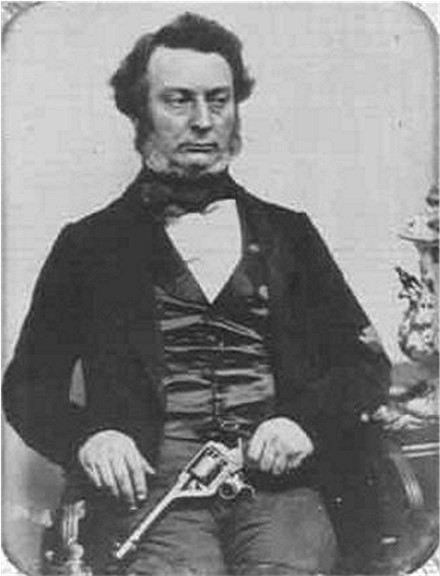
William
Tranter holding \one of his pistols
Tranter continued to produce percussion revolvers well
after the introduction of cartridge revolvers, however
in 1863 Tranter recognized the emerging technology and
he secured patents for rimfire chambered revolvers
ranging from small caliber single and double action
revolvers to the larger solid frame Model 1863 revolver
in .442 in caliber. In turn, Tranter began manufacturing
center fire revolvers in 1868. Between 1849 and 1888
Tranter submitted twenty-four patent applications;
nineteen of those were for cartridge weapons including
bolt-action rifles and machine guns, as well as his
famous revolvers.
In late 1867 Tranter constructed a new, larger facility
on Lichfield Road in Aston Cross, called "The Tranter
Gun and Pistol Factory”. At that time Tranter operated
the most extensive pistol-making business in the
Midlands, producing over twenty different pistols of his
own design, together with other designers' guns he
manufactured under contract. In addition, he held
government contracts for the official British Snider
Rifle, and in 1878 was granted a government contract for
a solid frame .450 centre fire revolver for use by the
British army.
Tranter retired in 1885 and died on January 7, 1890.
His factory was leased by his friend George Kynoch and
was renamed The Kynoch Gun Factory. In 1888 the name
was changed to the Aston Arms Factory, which had ceased
operation by 1900 when the factory was occupied by the
Clipper Automatic Tyre Co. The factory building was
ultimately demolished in 1961.
At some point after Tranter’s retirement, these three
milling bits moved into the collectors’ world, perhaps
initially as souvenirs taken by one of his machinists
and it is not known which of Tranter’s firearms they
were used to produce. What is known, thanks to the tags
attached to each bit, is that they eventually passed
into the possession of Douglas Nie, a well respected
authority on the subject of Tranter Firearms. Nie was
apparently a citizen of, and resided in the United
Kingdom, and coauthored several articles on Tranter
Firearms with De Witt Bailey which were published in
periodicals in England and throughout the Commonwealth,
and he contributed to at least one book, Firearms of
William Tranter – Birmingham Gunsmith, by Ron Stewart.
Stewart cites correspondence with Nie as one of his
sources. The Tranter collecting community has
recognized, and apparently still uses, a data sheet
created by Nie for identifying the characteristics of
the different models of Tranter revolvers which he
prepared while researching a book of his own on the
subject. Unfortunately Nie died before that work could
be finished and published. Based on Nie’s obvious
interest in Tranter firearms, his recognized expertise
on the subject and the recognition of his knowledge
within the Tranter collecting community, that these
milling bits were something he collected is certainly
plausible, and their provenance to the Tranter gun works
is definitely reinforced.
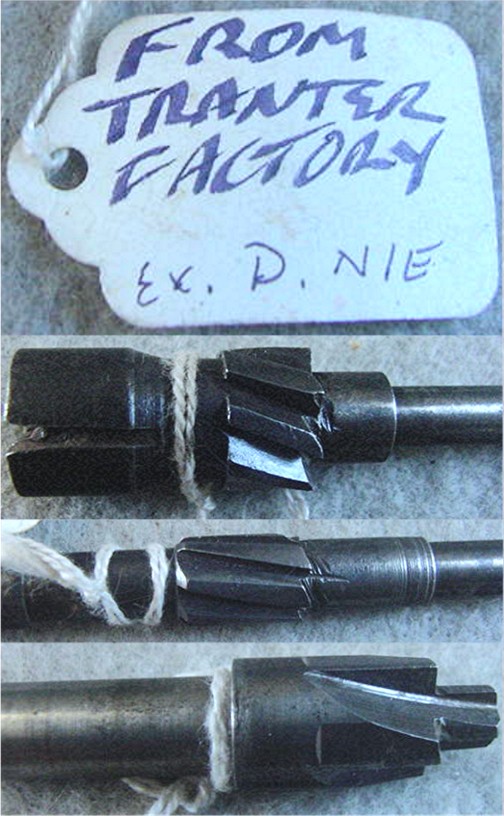
These three milling bits were acquired as a set in a
collection of antique gun tools and parts, and at that
time, each was identified with the tags as they present
here. Each tag bears the inscription, hand written in
ink, “FROM TRANTER FACTORY ex. D. NIE”. On the reverse
of each tag was written in the same hand, in the same
ink, a price with a U.S. dollar sign, indicating they
were offered for sale here in the United States. The
tags on bits 1 and 2 also bear the notation “RIMMING
TOOL”.
That gun manufacturer factory production tools are
rarely offered on the collectors’ market is not
surprising. That someone would have had the foresight
to regard the tools as having any historical value would
be asking a bit much – especially when viewed in the
context of how the patterns, tools and gauges from such
a historic entity as the Springfield Armory were treated
in such a cavalier manner and disposed of as so much
scrap metal when the armory was closed and turned over
to the National Park Service and the Commonwealth of
Massachusetts. You just can’t fix that kind of stupid.
So, against all reasonable odds, these three milling
bits have survived their use on the production line, the
end of the Tranter Firearms trade, and finally the
closing and physical destruction of the factory
building, making them a rare offering, indeed. They
would be a significant addition to any collection of
related firearms.
There are three milling bits
included in this offering, each described below with
accompanying photographs and all three are included as a
set for the one price.
(0726) $450
|